Skip to content
  • TAI MODERN
  • Artists
  • Exhibitions
  • Gallery
  • About Japanese Bamboo Art
  • Japanese Bamboo Art
    • Represented Artists
    • Historic Works
    • About Japanese Bamboo Art
  • Contemporary Art
    • Represented Artists
    • Works Available By
  • Exhibitions
    • Current Exhibitions
    • Past Exhibitions
  • Gallery
  • Contemporary American and Japanese Bamboo Art
  • Japanese Bamboo Art
    • Represented Artists
    • Historic Works
    • About Bamboo Art
  • Contemporary Art
    • Represented Artists
    • Works Available By
  • Exhibitions
    • Current Exhibitions
    • Past Exhibitions
  • Gallery
Back to Exhibition
  • Works
  • Statement
  • Bio/CV
  • Curriculum Vitae (PDF)
  • Videos
  • Catalogues
  • Exhibitions
  • Press
  • Next Work
  • Previous Work
  • Back to Artist Page
  • Print
  • Send Inquiry
  • < Lance Letscher
  • Monden Yuichi >
Monden Kogyoku
131297
811
Monden Kogyoku

Monden Kogyoku

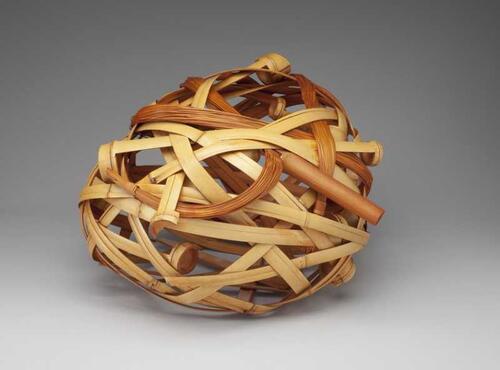
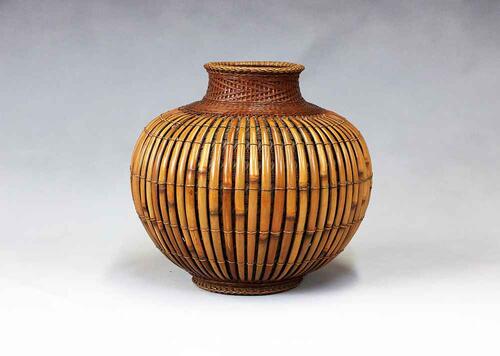
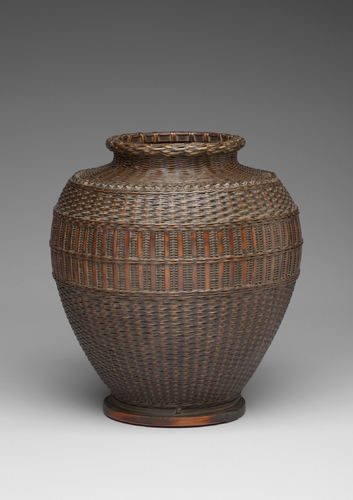
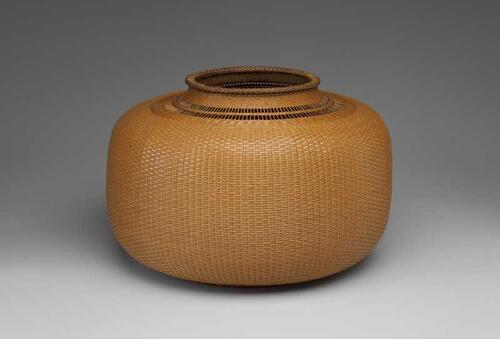
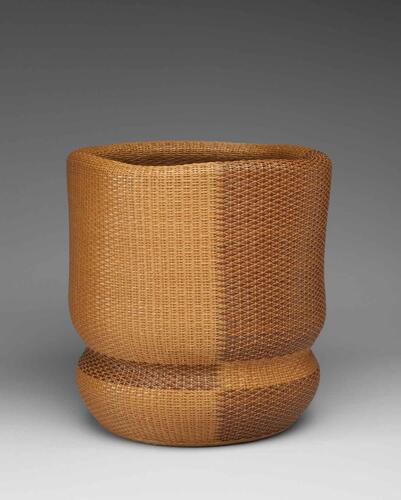
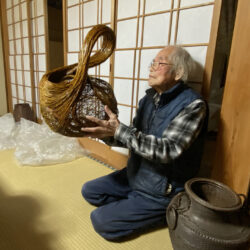
Kogyoku, which means “bamboo grove treasure,” is Monden’s artistic name, given to him when he was 21, a few short years after he began making bamboo baskets. His long and prestigious career has been marked with numerous honors and has been uninterrupted except for two decades after the war when economic turmoil required he make thousands of utilitarian baskets for sale to wholesalers. This period ended when a local department store manager, learning of his reputation, invited him to present an exhibition of flower baskets.

Monden, who lives near Hiroshima, became a full member of the Japan Craft Arts Exhibition in 1991, is an active leader in his prefecture, a judge for many regional exhibitions, and a teacher at the community college in Fukuyama City. His work is included in collections at the Denver Art Museum, San Francisco Asian Art Museum, and Mint Museum in Charlotte, NC.

The artist tells his students, “Don’t imitate others; create your own personal style. And don’t be afraid of making mistakes. Even if it’s bad, you will gain something in your efforts.”

  • Thumbnails
  • BIO/CV
  • Articles
  • Publications
  • Exhibitions
description

Kogyoku, which means “bamboo grove treasure,” is Monden’s artistic name, given to him when he was 21, a few short years after he began making bamboo baskets. His long and prestigious career has been marked with numerous honors and has been uninterrupted except for two decades after the war when economic turmoil required he make thousands of utilitarian baskets for sale to wholesalers. This period ended when a local department store manager, learning of his reputation, invited him to present an exhibition of flower baskets.

Monden, who lives near Hiroshima, became a full member of the Japan Craft Arts Exhibition in 1991, is an active leader in his prefecture, a judge for many regional exhibitions, and a teacher at the community college in Fukuyama City. His work is included in collections at the Denver Art Museum, San Francisco Asian Art Museum, and Mint Museum in Charlotte, NC.

The artist tells his students, “Don’t imitate others; create your own personal style. And don’t be afraid of making mistakes. Even if it’s bad, you will gain something in your efforts.”

BIO/CV

Monden Kogyoku
1916-2021, Hiroshima, Japan

Education
  • 1933

    Apprenticed to Kadota Niko


Exhibitions & Accolades
  • 1935

    Winner of “The Governor’s Award” at Oita Prefecture Art Exhibition (three consecutive years)

  • 1937

    Admitted to National Craft Exhibition

  • 1974

    Winner of “Governor of Okayama Award” at Japan Modern Craft Arts Exhibition, Chugoku Division

  • 1976

    Winner of “Governor of Hiroshima Award” and“Association Chief’s Award” at Prefectural Exhibition of Modern Craft Artists Association

  • 1977

    Winner of “H Award” at Hiroshima Kofukai Exhibition

  • 1979

    Winner of “Japan New Craft Award” at 1st Japan New Craft Exhibition

  • 1984

    Winner of “T Award” at Hiroshima Kofukai 70th Anniversary Exhibition

  • 1985

    Admitted to Kofukai Exhibition
    Admitted to Japan New Craft Art Exhibition

  • 1986

    Judge at Fukuyama City Art Exhibition
    Judge at Hiroshima Prefecture Art Exhibition

  • 1987

    Admitted to Japan Traditional Craft Arts Exhibition (13 times)

  • 1991

    Became full member of Traditional Craft Arts Association

  • 1996

    Winner of Sanyo Newspaper Award

  • 1997

    Winner of Cultural Award from Hiroshima Television

  • 2000

    Winner of Hiroshima Culture Award
    Bamboo Masterworks, Asia Society, New York City, NY

  • 2001

    Bamboo Masterworks, Asian Art Museum of San Francisco, CA

  • 2002

    Bamboo Masterworks, Honolulu Academy of Art, HI
    Bamboo Fantasies, TAI Gallery, Santa Fe, NM

  • 2003

    The Classic Japanese Basket, TAI Gallery, Santa Fe, NM

  • 2004

    The Hand Workshop Art Center, Richmond, VA

  • 2017

    Japanese Bamboo Art: The Abbey Collection, Metropolitan Museum of Art, New York, NY
    Masterpieces of Japanese Bamboo Art, TAI Modern at Joan B Mirviss LTD, New York, NY

  • 2019

    Japanese Bamboo Art from New York: The Abbey Collection, Oita Prefectural Art Museum, Japan
    Japanese Bamboo Art from New York: The Abbey Collection, The National Museum of Modern Art, Tokyo Crafts Gallery, Japan
    Japanese Bamboo Art from New York: The Abbey Collection, Museum of Oriental Ceramics, Osaka, Japan


Museum Collections
  • Asian Art Museum, San Francisco, CA
    Metropolitan Museum of Art, New York, NY
    Denver Art Museum, CO
    Philadelphia Museum of Art, PA
    Mint Museum of Craft + Design, Charlotte, NC
    Fukuyama Museum of Art
    Hiroshima Prefecture Art Museum
    Eskenazi Museum of Art at Indiana University, Bloomington, IN


ARTIST STATEMENT
PRESS
  • Bamboo crafts: Woven into Japan’s art history

    Left to right: Chikuunsai Tanabe IV’s “GATE” (2019) and Kenichi Nagakura’s “Flower Basket, ‘Woman (A Person)'” (2018) | © T. MINAMOTO; THE ABBEY COLLECTION, PROMISED GIFT OF DIANE AND ARTHUR ABBEY TO THE METROPOLITAN MUSEUM OF ART. IMAGE © THE METROPOLITAN MUSEUM OF ART SHARE The Abbey Collection of bamboo arts and crafts, the 20-year […]
  • Weaving a tale: Bamboo arts at The Met

    Original article at NY Press.com   Entering The Met Fifth Avenue’s Arts of Japan galleries, many visitors can’t help but gasp. We did. The guard on duty said it’s a common response. The exhibition title and signage promised bamboo baskets. It didn’t say anything about a floor-to-ceiling twisting mass of frenetic energy in a site-specific […]
  • PRESS RELEASE: TAI Modern at Art Miami 2017

    FOR IMMEDIATE RELEASE: TAI Modern at Art Miami 2017 December 5th– 10th, 2017 One Herald Plaza, Miami, FL Contact: Arianna Borgeson Arianna@taimodern.com (505) 984-1387 TAI Modern is pleased to announce its participation in the 28thyear of Art Miami. This year’s fair will be held at a new location at One Herald Plaza, on 14thStreet between […]
  • PRESS RELEASE: TAI Modern at Asia Week New York

    FOR IMMEDIATE RELEASE: TAI Modern at Asia Week New York Realization of Form: Masterworks of Japanese Bamboo Art March 15th– 24th, 2018 Exhibiting at Jason Jacques Gallery 29 East 73rd St, Apt. 1 New York, NY  10021 NEW YORK, NEW YORK—TAI Modern is pleased to announce its participation in Asia Week New York 2018. The […]

Bamboo crafts: Woven into Japan’s art history

The Japan Times, BY MATTHEW LARKING, FEB 26, 2020

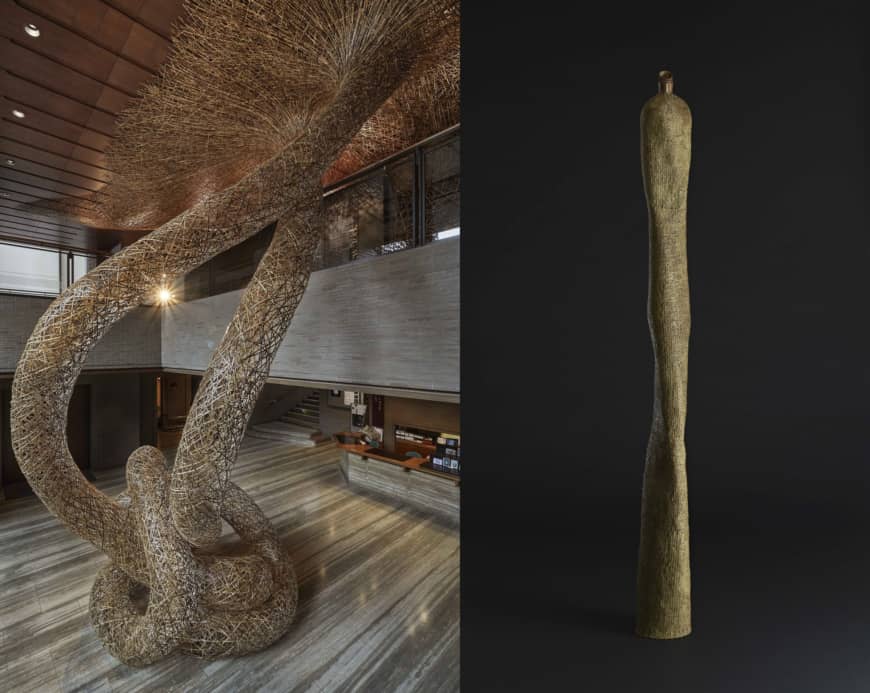
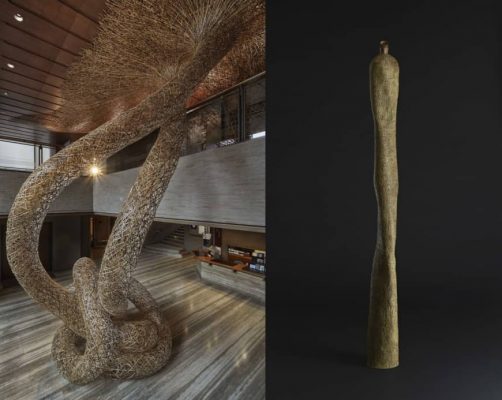
Left to right: Chikuunsai Tanabe IV’s “GATE” (2019) and Kenichi Nagakura’s “Flower Basket, ‘Woman (A Person)'” (2018) | © T. MINAMOTO; THE ABBEY COLLECTION, PROMISED GIFT OF DIANE AND ARTHUR ABBEY TO THE METROPOLITAN MUSEUM OF ART. IMAGE © THE METROPOLITAN MUSEUM OF ART

  • SHARE

The Abbey Collection of bamboo arts and crafts, the 20-year loving labor of New York collectors Dianne and Arthur Abbey, attracted 470,000 visitors when it showed at the Metropolitan Museum of Art, New York, in 2017-18. A traveling exhibition of some 75 pieces, which is now making a stop at The Museum of Oriental Ceramics, Osaka, makes for captivating and edifying viewing.

Japan’s ubiquitous bamboo is unsurprisingly storied. Woven artifacts evidence from the later Jomon Period (10,000-200 B.C.). The ancient nation- and culture-building texts, the “Kojiki” (Records of Ancient Matters) and “Nihon Shoki” (“The Chronicles of Japan”), record bamboo knives and combs with magical powers. The oldest surviving baskets are 8th-century offering trays kept in the Shosoin treasure house in Nara. Bamboo was obviously crucial to the 10th-century prose narrative “Taketori Monogatari” (“Tale of the Bamboo Cutter”). Tea masters of the 15th century revered seemingly artless utensils in their burgeoning spiritual practice. Emperors were gifted the choicest of bamboo wares.

But it was only comparatively recently that bamboo crafting became considered fine art. The exhibition’s chronology from the 19th century indicates how this came about by participation in Japan’s National Industrial Exhibition and the world fairs.

Hayakawa Shokosai I (1815-1897) engraved his name on his pieces — Edo Period (1603-1868) craftsmen did not do this. One of his lidded baskets won the Phoenix Prize in the first National Industrial Exhibition in Tokyo’s Ueno Park in 1877, then was acquired by the Empress Shoken. Hayakawa’s plaited “Bowler Hat” (ca. 1880-90s) was a favorite of the Meiji Era (1868-1912) kabuki performer, Ichikawa Danjuro IX (1838-1903).

Tanabe Chikuunsai I (1877-1937) received an award at the International Exhibition of Modern Decorative and Industrial Arts in Paris in 1925 — the showcase that introduced Art Deco to the world. This reception suggested bamboo artists could acquire the recognition Japanese ceramic and lacquer artists had previously achieved. Tanabe’s “Ryurikyo Hanging Flower Basket” (1900-20) was made after studying the baskets in works by the literati painter Yanagisawa Kien (1704-1758).

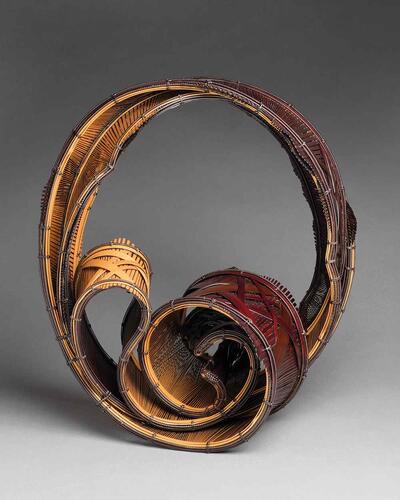
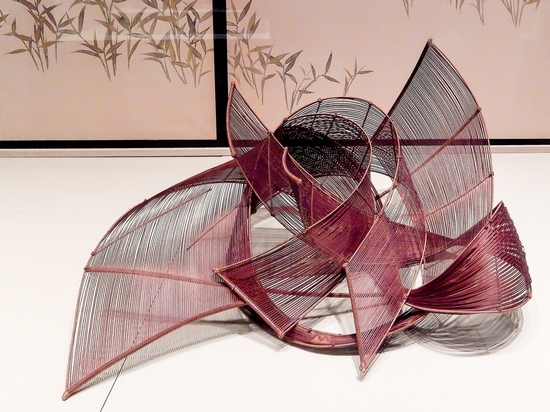
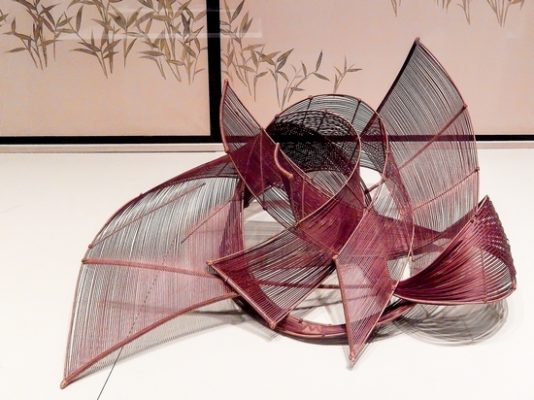
Individual creative flourishes followed in the Showa Era (1926-89), like Monden Kogyoku’s abstracted circular “Wave” (1981). Such pieces pushed craft further into art territory. But it was not until 1985 that there was even a significant historical review in Japan, “Modern Bamboo Craft: Developments in the Modern Era” at The National Museum of Modern Art, Tokyo.

Overseas collectors assumed some of the mantle. California’s Lloyd Cotsen (1929 -2017) assembled a vast collection of basketry that showed around America before being donated to the Asian Art Museum of San Francisco in 2002. Argentinian Guillermo Bierregaard created a museum for his collection in Buenos Aires 2006. The Stanley and Mary Ann Snider Collection went to the Museum of Fine Arts, Boston. Now the Abbey Collection is a promised gift to New York’s Met.

Further exhibition pieces extend into the entirely contemporary. Kenichi Nagakura (1952-2018) is represented by an elongated personification, “Flower Basket, ‘Woman (A Person)” (2018), and an interdimensional wormhole-type construction, “Gate” (2019) by Tanabe Chikuunsai IV, is installed in the museum lobby. Intensified focus will fall further on Tanabe IV in May through June, then in July, with his solo exhibitions scheduled for the Osaka and Nihonbashi Takashimaya department stores.

“Japanese Bamboo Art from New York: The Abbey Collection” at The Museum of Oriental Ceramics, Osaka, runs through April 12; ¥1,200. For more information, visit www.moco.or.jp/en.
Weaving a tale: Bamboo arts at The Met

Original article at NY Press.com


Entering The Met Fifth Avenue’s Arts of Japan galleries, many visitors can’t help but gasp. We did. The guard on duty said it’s a common response. The exhibition title and signage promised bamboo baskets. It didn’t say anything about a floor-to-ceiling twisting mass of frenetic energy in a site-specific installation by Tanabe Chikuunsai IV.”The Gate,” woven of tiger bamboo, torques and twirls like a funnel cloud, or the tendrils of a great vine, or the circulatory system of some unseen giant. It’s at once ethereal and overpowering, weightless and crushing. It’s extraordinary.

At home, our kitchen counter usually holds two or three bamboo baskets filled with bananas and apples or unsorted mail. It was clear from this introduction that the work in the exhibition that followed would have little to do with our everyday experience of bamboo.

Japanese Bamboo Art: The Abbey Collection” highlights some 90 works in bamboo, from functional baskets to abstract sculptures, that date from the late 1800s to the present. It’s The Met’s first exhibition focusing on basketry, and most of the works have never been on public view before. New York residents Diane and Arthur Abbey have amassed one of the most comprehensive and exquisite collections of a form that has only recently been considered fine art. Yet, six of the artists whose work is on view have been recognized in Japan as Living National Treasures.

From delicate grasses to timber towering five stories high, the more than 60 varieties of bamboo that are native to Japan have become woven into the arts, culture and daily lives of the society for hundreds of years. Its shoots are a dietary staple, and it’s been used to make kitchen utensils, furniture, hats and shoes, transportation devices for everything from medicine to travelers, and even bridges, roads and buildings. Called one of the “three friends of winter,” along with pine and plum trees, bamboo doesn’t succumb to cold, grows quickly, and bestows its gifts to animals and humans with grace. It bends without breaking and is thought of as steadfast and loyal. For all these reasons, the venerable and venerated plant has been depicted and utilized by artists for ages.

One of the pleasures of the exhibition is the engaging way that curator, Monika Bincsik, has woven the Abbeys’s baskets through a presentation of The Met’s superb collection of screens, woodblock prints, Inrō containers, manuscripts and ceramics. Each gallery contains conversations between basketry and other objects, expressed in the language of bamboo, but with almost infinite dialects and inflections. One case presenting a glorious painted manuscript had me wondering what it was doing there, until I read the title of the story: “The Tale of the Bamboo Cutter.” Bamboo imagery throughout the galleries decorates delicate fans, massive folding screens and antique porcelains.

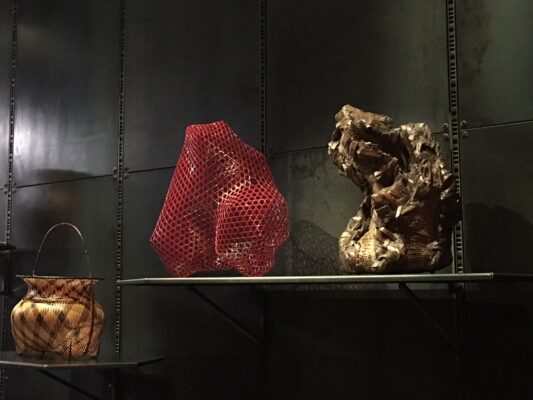
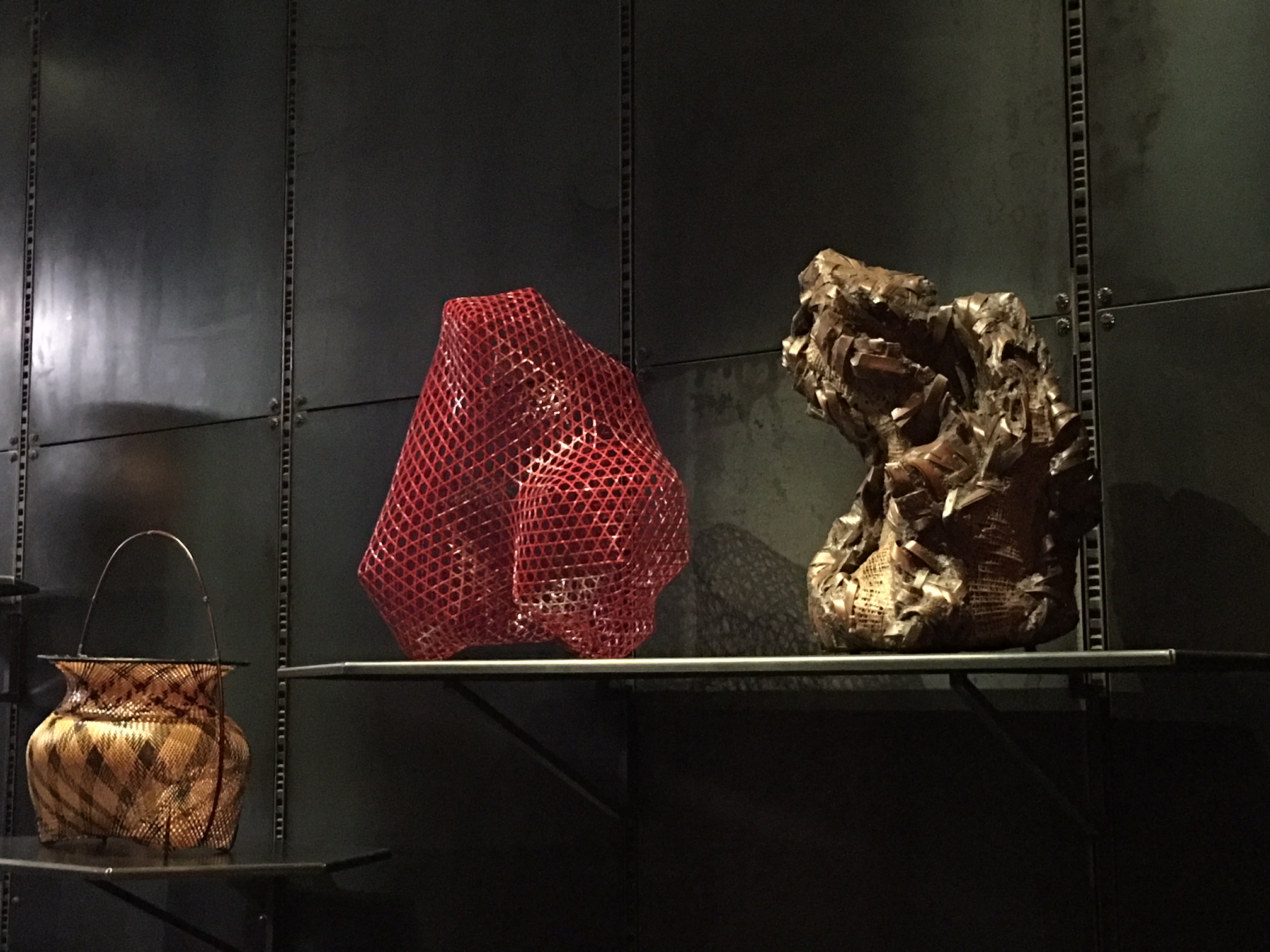
But it’s the baskets that carry the exhibition. Many were created to hold ikebana floral arrangements, a classical art of spiritual refinement. They range from minutely detailed to radically abstract, and from traditional to uncompromisingly contemporary. “Tide,” a 1978 work by Fujitsuka Shōsei, displaying the “thousand line” technique is beautifully placed in front of a screen decorated with painted bamboo leaves. Nagakura Ken’ichi’s “Woman Flower Basket,” tall and spindly, recalls a Giacometti figure. A dramatically lit, black-lined case holding two objects is a show stopper. In “Wave,” created by Monden Kōgyoku in 1981, a rolling mass of energy coils in on itself. Next to it is the 2000 work, “Dance,” by Honda Shōryū. It pliés and twirls with elegance, precision and grace.

“Japanese Bamboo Art: The Abbey Collection” presents a sweeping view across centuries and media with spectacular forms expressing a humble and hardy, but hardly plain plant.

PRESS RELEASE: TAI Modern at Art Miami 2017

FOR IMMEDIATE RELEASE:

TAI Modern at Art Miami 2017
December 5th– 10th, 2017
One Herald Plaza, Miami, FL

Contact:
Arianna Borgeson
Arianna@taimodern.com
(505) 984-1387

TAI Modern is pleased to announce its participation in the 28thyear of Art Miami. This year’s fair will be held at a new location at One Herald Plaza, on 14thStreet between the Venetian and MacArthur Causeways. Art Miami opens with a VIP preview on Thursday, December 5th, and runs through Sunday, December 10th. TAI Modern will be exhibiting recent works by contemporary Japanese bamboo masters, as well as contemporary American artists of various media.

For TAI Modern’s return to the fair, the gallery will present works which reflect the continued development of the Japanese bamboo arts. Representing over 35 artists in this medium, including Living National Treasure Fujinuma Noboru, TAI Modern has been the premier gallery for contemporary Japanese bamboo art for over 20 years. Other noteworthy bamboo artists include Honda Syoryu, Fujitsuka Shosei, and Nagakura Kenichi, who each exemplify varying traditional and regional aesthetics with their unique sculptural styles. These artists have pieces in several major American museum collections, including the Metropolitan Museum of Art, which is featuring its first exhibit of Japanese bamboo art.

To compliment the selection of Japanese bamboo, TAI Modern will also feature works by contemporary American painters Erik Benson, Siobhan McBride, and Monique van Genderen. Benson’s work is highly detailed with an urban edge, creating cityscapes with his signature technique of cutting shapes from acrylic paint and applying them to canvas. McBride’s work is fragmented and dream-like, her subject matter and color choice represent a combination of the mundane and unfamiliar.  In contrast, van Genderen’s work focuses more on the versatility of her color and her use of direct brushstrokes, which result in highly lyrical compositions.

For more information about Art Miami or to request a pass to the fair, please contact Arianna Borgeson at arianna@taimodern.com, or (505) 984-1387.

PRESS RELEASE: TAI Modern at Asia Week New York

FOR IMMEDIATE RELEASE:

TAI Modern at Asia Week New York
Realization of Form: Masterworks of Japanese Bamboo Art
March 15th– 24th, 2018

Exhibiting at Jason Jacques Gallery
29 East 73rd St, Apt. 1
New York, NY  10021

NEW YORK, NEW YORK—TAI Modern is pleased to announce its participation in Asia Week New York 2018. The exhibition, Realization of Form: Masterworks of Japanese Bamboo Art, will be on view March 15-23 at Jason Jacques Gallery, 29 East 73rd St, Apt. 1, New York, NY. An opening party will take place Friday, March 16th, 6-9 pm.

For TAI Modern’s first year participating in Asia Week, the gallery will present both historic and contemporary works which exemplify the dialogue that occurs between the artist and the bamboo. “Bamboo art is a material specific art,” Director of Japanese Art Koichi Okada explains. “This exhibition explores the relationship between artists and their chosen medium. Monozukuriis a term often used by Japanese artists and craftsmen. It can be described as ‘the process of creating an object in harmony with the medium through pride of craftmanship.’”

Veteran artists often speak of the necessity of listening to the bamboo. One might wait years to find the right bamboo for a basket or the right form for a particular piece of bamboo. Artist Tanioka Aiko described her bond with the material, saying “This medium gives me joy and challenges me…Bamboo is both delicate and powerful. It is not a tame material to shape according to my desire. It gives me joy when my will and the will of the bamboo fit together nicely.”

Among the more than 30 bamboo artists in the exhibition are noteworthies such as 101-year old Monden Kogyoku, Living National Treasure Fujinuma Noboru, and cult-favorite Tanioka Shigeo, each of whom excel at expressing the unique character of bamboo. These artists are in several major American museum collections, including the Metropolitan Museum of Art, Asian Art Museum, and the Art Institute of Chicago.

TAI Modern has been the premier gallery for contemporary Japanese bamboo art for over 20 years, and currently represents over 35 artists in this medium. During Asia Week New York, TAI Modern’s exhibition at Jason Jacques Gallery will be available for viewing Monday through Saturday from 10am-6pm or by appointment.

For more information, please contact Arianna Borgeson at arianna@taimodern.comor (505) 984-1387.

  • Masterpieces of Japanese Bamboo Art
    June 14, 2017–July 6, 2017
  • Father & Son: 107 Years of Bamboo Art - Monden Kogyoku & Yuichi
    July 24, 2010–July 31, 2010
  • Hobi Bamboo Flower Basket
    Hobi Bamboo Flower Basket
  • Revive
    Revive
  • Shore
    Shore
  • Square Flower Basket
    Square Flower Basket

Tuesday–Saturday
10am–5pm


1601 Paseo de Peralta
Santa Fe, NM 87501
(505) 984 1387

FB LinkInstagram LinkYouTube LinkPinterest LinkTwitter LinkArtsy Link

/detail/?artistId=158350&offset=0&historic
/detail/?artistId=131353&offset=0&historic
/detail/?artistId=131313&offset=0&historic
/detail/?artistId=438148&offset=0&historic
/detail/?artistId=131261&offset=1&historic
138778
379223
324077
131264
131282
131283
131284
437132
290764
132133
354172
156549
131288
437130
131267
132134
438817
131289
131258
131320
131291
275525
131293
137906
131295
290914
137911
131297
131298
131276
131280
131299
131266
137912
131301
280559
437134
131356
131321
430063
131307
131305
131306
131309
131257
131322
437128
131274
131311
131259
131271
131316
131287
131008
130963
131049
131085
131164
131109
130991
130888
274796
131047
130966
440262
130977
131087
130878
131086
436152
131097
130918
131088
130970
130883
131057
439293
131096
130968
131247
337926
130895
130893
131043
130917
130920
130905
131228
131143
131008
130963
131049
131085
131109
130991
130888
131047
130966
440262
437132
130977
437130
131087
130878
131086
436152
131097
131088
130970
130883
131057
439293
131096
130968
131247
337926
131043
130905
437128