Skip to content
  • TAI MODERN
  • Artists
  • Exhibitions
  • Gallery
  • About Japanese Bamboo Art
  • Japanese Bamboo Art
    • Represented Artists
    • Historic Works
    • About Japanese Bamboo Art
  • Contemporary Art
    • Represented Artists
    • Works Available By
  • Exhibitions
    • Current Exhibitions
    • Past Exhibitions
  • Gallery
  • Contemporary American and Japanese Bamboo Art
  • Japanese Bamboo Art
    • Represented Artists
    • Historic Works
    • About Bamboo Art
  • Contemporary Art
    • Represented Artists
    • Works Available By
  • Exhibitions
    • Current Exhibitions
    • Past Exhibitions
  • Gallery
Back to Exhibition
  • Works
  • Statement
  • Bio/CV
  • Curriculum Vitae (PDF)
  • Videos
  • Catalogues
  • Exhibitions
  • Press
  • Next Work
  • Previous Work
  • Back to Artist Page
  • Print
  • Send Inquiry
  • <
  • >
130897
809

The beauty of nature has long captivated man, but the relationship many have with nature is largely optical. America has no shortage of stunning sunset, snow-capped peaks and intriguing rock formations, all of which inspire snapshots and persistent visual memories.

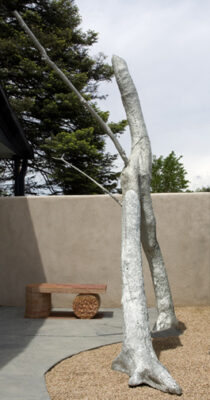
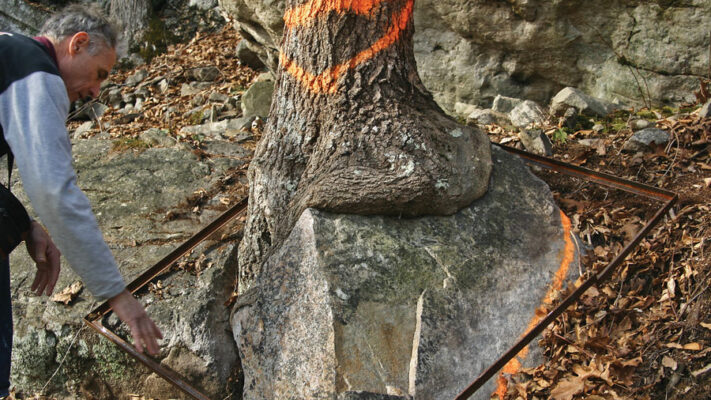
There is also a more intimate side to nature, which I seek to capture in my sculptures and wall pieces. My work is fundamentally hands-on, created on-site through the use of trees and other forest dwellers via the technique of repousse. Through the use of a gas-powered air compressor, hundreds of yards of hoses and an extensive toolbox, aluminum is hammered, stretched and tightened around natural objects to sculpt the skin of the forest.

This fictitious surface does not mimic or recreate nature, but rather pushes nature’s intrinsic qualities to the surface. There is intimacy, anthropomorphism and mythology in the woods, and by becoming art, there is also machinery.

The resulting works investigate the divide between representation and abstraction, stripping nature’s unique imprints of their color, detail and texture. This abstract quality is further advanced by the explicit cropping of the art and its displacement from its original environment.

While I work primarily in a forest along the Appalachian Trail, I have also worked in the Adirondacks, the Berkshires, Nova Scotia and California. Before I can begin working in a space, I must familiarize myself with it and find an idea grounded in that space. Even an acre of forest can provide a lifetime of inspiration.

My work comes out of classical sculpture, including minimalist art and modernist sculpture, and begins with process, with the idea of hammering aluminum around trees and condensing all that detail on the skin.

The process continues in the studio, where the metal molds are assembled, heat-treated and sometimes anodized. I have been working with aluminum for nearly 40 years, when I felt a desire to incorporate the vastness of nature, both the way it looks and the way it might feel, into art.

Nature abstracted as such is ideally hard to conceive, like a riddle that keeps coming back into your head. There is something that you cannot identify or define, but that you have to touch. It can’t be recreated, and each time you touch or view it, it seems different. And there is something about grasping this in a tactile way that people relate to.

  • Thumbnails
  • BIO/CV
  • Statement
  • Articles
  • Videos
description
BIO/CV

1945, Detroit, MI

Education
  • 1968

    MFA, Hunter College, New York, NY

  • 1967

    BA, Oberlin College, Oberlin, OH


Selected One Person Exhibitions
  • 2018                      

    Private Viewing, West Broadway Gallery, New York, NY

  • 2015

    In the Forest of Drawn Metal, Grounds for Sculpture, Hamilton Township, NJ
    Field Studies, Mohonk Preserve, New Paltz, NY

  • 2011                       

    Nature in Nature, The Audubon Center at The Boat House and Lullwater in Prospect Park, Brooklyn, NY

  • 2010

    Robert Lobe, LUX Art Institute, Encinitas, CA

  • 2006                     

    Robert Lobe: Sculpture, Douglas Udell Gallery, Vancouver, BC
    The Landscape Transformed, Montalvo Arts Center, Saratoga, CA

  • 2005                     

    Ne Cede Malis, Stags’ Leap Winery Salon Series, Stags’ Leap, Napa, CA

  • 2004                     

    Four Trees, Montclair Art Museum, Montclair, NJ

  • 2003

    Robert Lobe, Senior & Shopmaker Gallery, New York, NY
    Works on Paper and a Sculpture, Texas Gallery, Houston, TX

  • 2002

    A Clearing In The Woods, The Katonah Museum, Katonah, NY
    Works on Paper and a Sculpture, Texas Gallery, Houston, TX

  • 2001                      

    Robert Lobe, Nina Freudenheim Gallery, Buffalo, NY

  • 2000                     

    Robert Lobe, Senior & Shopmaker Gallery, New York, NY

  • 1997                      

    Robert Lobe, Grounds for Sculpture, Hamilton, NJ
    Robert Lobe/Sculpture on the Grounds, Southeast Center for Contemporary Art, Winston-Salem, NC

  • 1996                     

    Natural Resources, Greater Reston Arts Center, Reston, VA

  • 1995                      

    The Palm at the End of the Parking Lot, Laumeier Sculpture Park, St. Louis, MO

  • 1992                      

    Robert Lobe, Blum Helman Warehouse, New York, NY
    Land Mindscape, City Gallery of Contemporary Art, Raleigh, NC
    Robert Lobe, Allene Lapidis Gallery, Sante Fe, NM

  • 1991                      

    Robert Lobe, Beth Urdang Fine Art, Boston, MA
    The Artist’s Sculpture – In The Woods of New Jersey, Department of Environmental Protection, Trenton, NJ

  • 1990

    Robert Lobe, Cleveland Museum of Art, Cleveland, OH

  • 1988                     

    On Nature, Blum Helman Gallery, Los Angeles, CA

  • 1986                     

    Robert Lobe, Willard Gallery, New York, NY

  • 1987                      

    Robert Lobe, Anderson Gallery, Virginia Commonwealth University, Richmond, VA

  • 1986

    Robert Lobe, Marian Locks Gallery, Philadelphia, PA

  • 1982                      

    Robert Lobe, Texas Gallery, Houston, TX

  • 1981                      

    Robert Lobe: Hammered Aluminum Sculpture, Willard Gallery, New York, NY

  • 1977                      

    Robert Lobe: Recent Sculpture, Dag Hammarskjold Plaza Sculpture Garden, New York, NY

  • 1974                      

    Wood Sculpture, Zabriskie Gallery, New York, NY


Selected Group Exhibitions
  • 2012                      

    Getting From Here to There: Images In and About Transition, AFP Gallery, NY
    Peekskill Project V, Hudson Valley Center for Contemporary Art, Peekskill, NY
    Dumbo Arts Festival, Brooklyn, NY

  • 2011                       

    Second Nature: Contemporary Landscapes from the MFA Collection, Houston Museum of Fine Arts, Houston, TX

  • 2009

    Forces of Nature, Danese Gallery, New York, NY
    Suspect Traces, Texas Gallery, Houston, TX

  • 2007

    Winter Park Art in Public Places, inaugural exhibition curated by Joyce Schwartz, City of Winter Park, FL
    Modern Dimensions: Contemporary American Sculpture, Eight Modern, Santa Fe, NM

  • 2006

    Tree Lines, Abington Art Center, Abington, PA)
    El Paseo Outdoor Sculpture Exhibition, City of Palm Desert, CA
    El Bosque, org. by Naomi Siegmann, Federico Silva Museum, San Luis Patosi, Mexico City; Santa Fe, NM; San Francisco, CA; Los Angeles, CA

  • 2005

    Drawn to Cleveland, Museum of Contemporary Art, Cleveland, OH

  • 2004

    179th Annual, National Academy of Design, New York, NY
    Blixen, Robert Lobe with Zac Posen, Fashion Week, Bryant Park, NY

  • 2003

    Outdoor Sculpture Invitational, The Gallery a t Bristol Myers Squibb, New Brunswick, NJ

  • 2002

    Tenth Anniversary Invitational, Grounds for Sculpture, Hamilton, NJ

  • 2001

    Sensing the Forest, Wave Hill, Bronx, NY

  • 2000

    2000 New Jersey Fine Arts Annual: Into the Millennium, The Newark Museum, Newark, NJ

  • 1999

    As Far As the Eye Can See, Atlanta College of Art, Atlanta, GA
    Six Degrees Of Seduction, Central Fine Arts, NY

  • 1998

    Spring Exhibition, Grounds For Sculpture, Hamilton, NJ
    Escape Velocity, Socrates Sculpture Park, Long Island City, NY
    The Edward R. Broida Collection, Orlando Museum of Art, Orlando, FL
    Inaugural Exhibition, The Fields Sculpture Park, Art/Omi, Ghent, NY
    Off The Wall: Eight Contemporary American Sculptors, Asheville Art Museum, Ashville, NC

  • 1997

    Multiple Identity: Amerikanische Kunst 1975-1995 aus dem Whitney Museum of American Art, Kunstmuseum Bonn

  • 1996                     

    Art at the End of the 20th Century: Selections from the Whitney Museum of American Art, National Gallery, Alexander Soutzos Museum, Athens
    Twentieth Century American Sculpture at the White House: Northeast Region, First Lady’s Garden, The White House, Washington, DC
    Contemporary Sculpture at Chesterwood, 1996, Chesterwood, Stockbridge, MA
    Sculpture New Jersey, The Art Gallery, Ramapo College, Mahwah, NJ

  • 1995                      

    Revisiting Landscape, California Center For The Arts, Escondido, CA
    Inaugural Exhibition, Margaret Woodson Fisher Sculpture Gallery, Leigh Yawkey Woodson Art Museum, Wausau, WI
    Inspiration, Trans Hudson Gallery, Jersey City, NJ

  • 1994                     

    Landscape Not Landscape, Gallery Camino Real, Boca Raton, FL
    Prints from Solo Impressions, The College of Wooster Art Museum, Wooster, MA

  • 1993                      

    Dialogue with Nature: Nine Contemporary Sculptors, The Phillips Collection, Washington, DC
    A Private View: Artists’ Photographs, Blum Helman Gallery, New York, NY
    Storm King Art Center, Mountainville, NY
    Grounds For Sculpture, Hamilton, NJ
    Drawings by Sculptors, Nancy Drysdale Gallery, Washington, DC
    Sex Money Politics, Nancy Drysdale Gallery, Washington, DC
    Sculpture/Prints, Bernard Toale Gallery, Boston MA

  • 1992                      

    Issues in Sculpture, 1960-1990, Marion Locks Gallery, Philadelphia PA
    Contemporary Wood Sculpture, Brooklyn Museum, Brooklyn NY
    Ellen H Johnson Collection: The Living Object, Allen Memorial Art Museum, Oberlin College, Oberlin OH
    DeCordova Museum and Sculpture Park, Lincoln MA

  • 1991                      

    Five Artists Reclaim Nature, Neuberger Museum, Purchase NY
    Acquisitions of the 80’s, Whitney Museum of American Art, New York, NY
    Sticks and Stones and Artists work with Nature, Katonah Museum of Art, Katonah, NY

  • 1989                     

    The Experience of Landscape – 3 Decades of Sculpture, Whitney Museum, New York, NY
    Summer Group Show, Blum Helman Gallery, New York, NY
    Works on Paper and Group Show on Eight, Blum Helman Gallery, New York, NY
    4 Americans: Aspects of Current Sculpture, The Brooklyn Museum, Brooklyn NY
    A Certain Slant of Light: The Contemporary American Landscape, Dayton Art Institute, Dayton OH)
    Ellen Driscoll, Robert Lobe, Ursula von Rydingsvard, Damon Brandt Gallery, New York, NY
    Selections from the Permanent Collection, Solomon R Guggenheim Museum, New York, NY
    The Unconventional Landscape, John Kohler Arts Center, Sheboygan, WI
    Terra Incognito: New Directions in Contemporary Art, Museum of Art, Rhode Island School of Design, Providence, RI
    Terra Firma: Land and Landscape in 1989, Wallach Art Museum, Columbia University, New York, NY

  • 1988                     

    Duff, Lobe, Saret: Working in Metal, Blum Helman Gallery, Los Angeles, CA
    Sculptors’ Drawings, Blum Helman Gallery, New York, NY
    In Bloom, The BMW Gallery, New York, NY
    Natural Sources: Contemporary Involvement with the Landscape, Honolulu Academy of Arts, HI
    Sculpture, Katzen Brown Gallery, New York, NY
    Enclosing the Void – Eight Contemporary Sculptors, Whitney Museum of Art at the Equitable Center, New York, NY
    The Lay of the Land, Rathbone Gallery, Russel Sage College, Albany, NY

  • 1987

    A Decade of Emerging Artists: Selections from the Exxon Series, Solomon R. Guggenheim Museum, New York, NY
    The Allusive Object: Mel Kendrick, Robert Lobe, Judith Shea, Barbara Krakow Gallery, Boston, MA
    The Tree Show, North Hall Gallery, Massachusetts College of Art, Boston, MA
    Sculptures by John Duff, Robert Lobe, Al Taylor, Lorence-Monk Gallery, New York, NY
    Contemporary American Landscape: Reflections of Social Change, New Jersey Center for the Visual Arts, Summit, NJ
    1987 Biennial, Whitney Museum of American Art, New York, NY

  • 1983                      

    American Sculptors from the Permanent Collection, Solomon R. Guggenheim Museum, New York, NY
    Directions in Abstraction; The Uses of Nature, High Museum of Art, Atlanta, GA

  • 1982                      

    Landscape in Sculpture, Freedman Gallery, Albright College, Reading, PA
    C.A.P.S. Sculptors, 1981-82, The Hudson River Museum, Yonkers, NY

  • 1981                      

    The Americans, The Landscape, Contemporary Arts Museum, Houston, TX
    Trois Dimensions-Sept Americains, Galerie Gillespie-Laage-Salomon, Paris
    Selected by Donald Sultan, Texas Gallery, Houston, TX
    Group Exhibition, Willard Gallery, New York, NY

  • 1979                      

    Eight Sculptors, Albright-Knox Art Gallery, Buffalo, NY

  • 1978                      

    Indoor/Outdoor Sculpture Show, Institute for Art and Urban Resources at P.S.1, Long Island City, New York

  • 1978                      

    Young American Artists: Exxon National Exhibition, Solomon R. Guggenheim Museum, New York, NY

  • 1977                      

    Documenta 6, Orangerie, Kassel
    Wood, Nassau County Museum of Art, Rosylan, NY
    The Material Dominant: Some Current Artists and their Media, Plamer Museum of Art, Pennsylvania State University, Pittsburg, PA

  • 1976                      

    A Month of Sundays, Institute for Art and Urban Resources at P.S. 1, Long Island City, NY

  • 1975                      

    Painting, Drawing and Sculpture of the 60s and 70s from the Dorothy and Herbert Vogel Collection, Institute of Contemporary Art, University of Pennsylvania, Philadelphia, PA
    Working Drawings by Sculptors, Kansas State College, Pittsburg, KS
    76 Jefferson Street, Museum of Modern Art, New York, NY
    Summer Exhibition, Storm King Art Center, Mountainville, NY

  • 1974                      

    The Levi Strauss Collection, San Francisco Museum of Art, San Francisco, CA
    Summer Exhibition, Storm King Art Center, Mountainville, NY

  • 1973                      

    Biennial Exhibition: Contemporary American Art, Whitney Museum of American Art, New York, NY

  • 1972                      

    Painting and Sculpture Today: 1972, Indianapolis Museum of Art, Indianapolis, IN

  • 1971                       

    Recent Acquisitions, Whitney Museum of American Art, New York, NY

  • 1970                      

    1970 Annual Exhibition: Contemporary American Sculpture, Whitney Museum of American Art, New York, NY

  • 1969

    Anti Illusion: Procedures/Materials, Whitney Musem of American Art, New York, NY
    Other Ideas, Detroit Institute of Arts, Detroit, MI
    Selections from the Eugene and Barbara Schwartz Collection, Everson Museum of Art, Syracuse, NY


Selected Residencies + Grants
  • 2005

    Pollock/Krasner Foundation Grant Recipient

  • 2003

    Pollock/Krasner Foundation Grant Recipient

  • 2001

    Joan Mitchell Foundation Grant Recipient

  • 1994

    Adolph and Esther Gottlieb Foundation Grant Recipient

  • 1993

    Elizabeth Foundation Grant Recipient

  • 1992

    Pollock/Krasner Foundation Grant Recipient

  • 1985

    Guggenheim Sculptor-in-Residence, Chesterwood, MA

  • 1984

    National Endowment for the Arts Fellowship

  • 1982

    Creative Artists Public Service Award

  • 1979

    National Endowment for the Arts Fellowship


Public Collections + Commissions
  • Art-in-Architecture Program, US Geological Survey Building, Reston, VA, 1996
    Niagara Frontier Transportation Authority, Amherst Station, Buffalo, NY
    Washington State Arts Commission, Eastern Washington University, Cheney, WA, 1993
    Laumeier Sculpture Park, St Louis, MO, 1995
    Albright-Knox Art Gallery, Buffalo, NY
    Allen Memorial Art Museum, Oberlin, OH
    Brooklyn Museum, Brooklyn, NY
    Castellani Art Museum, Niagara Falls, NY
    The Cleveland Museum of Art, OH
    The Contemporary Museum, Honolulu, HI
    Detroit Institute of Arts, MI
    De Cordova Museum and Sculpture Park, Lincoln, MA
    Honolulu Academy of Art, HI
    Indianapolis Museum of Art, IN
    Mihama-cho International Outdoor Sculpture Garden, Mihama-cho
    Milwaukee Art Museum, WI
    Museum of Contemporary Art, Los Angeles, CA
    Museum of Fine Arts, Houston, TX
    National Gallery, Washington, D.C. (Vogel Collection)
    Newark Museum, Newark, NJ
    Solomon R. Guggenheim Museum, New York, NY
    The Menil Collection, Houston, TX


ARTIST STATEMENT

The beauty of nature has long captivated man, but the relationship many have with nature is largely optical. America has no shortage of stunning sunset, snow-capped peaks and intriguing rock formations, all of which inspire snapshots and persistent visual memories.

There is also a more intimate side to nature, which I seek to capture in my sculptures and wall pieces. My work is fundamentally hands-on, created on-site through the use of trees and other forest dwellers via the technique of repousse. Through the use of a gas-powered air compressor, hundreds of yards of hoses and an extensive toolbox, aluminum is hammered, stretched and tightened around natural objects to sculpt the skin of the forest.

This fictitious surface does not mimic or recreate nature, but rather pushes nature’s intrinsic qualities to the surface. There is intimacy, anthropomorphism and mythology in the woods, and by becoming art, there is also machinery.

The resulting works investigate the divide between representation and abstraction, stripping nature’s unique imprints of their color, detail and texture. This abstract quality is further advanced by the explicit cropping of the art and its displacement from its original environment.

While I work primarily in a forest along the Appalachian Trail, I have also worked in the Adirondacks, the Berkshires, Nova Scotia and California. Before I can begin working in a space, I must familiarize myself with it and find an idea grounded in that space. Even an acre of forest can provide a lifetime of inspiration.

My work comes out of classical sculpture, including minimalist art and modernist sculpture, and begins with process, with the idea of hammering aluminum around trees and condensing all that detail on the skin.

The process continues in the studio, where the metal molds are assembled, heat-treated and sometimes anodized. I have been working with aluminum for nearly 40 years, when I felt a desire to incorporate the vastness of nature, both the way it looks and the way it might feel, into art.

Nature abstracted as such is ideally hard to conceive, like a riddle that keeps coming back into your head. There is something that you cannot identify or define, but that you have to touch. It can’t be recreated, and each time you touch or view it, it seems different. And there is something about grasping this in a tactile way that people relate to.

  • Nature in Nature: Robert Lobe in Prospect Park

    In traditional Japanese gardens, art and nature are so delicately nuanced and balanced that it is often difficult to discern where, exactly, nature ends and art begins.  The natural and the handmade–wilderness and rationality–are in harmony. Sculptor Robert Lobe (b.1945) may not have the sensitivity of a Japanese gardener (his blunt forms are equally indebted […]
  • Robert Lobe’s rural Repoussé

    Embellishing the manicured landscape that surrounds the U.S. Geological Survey Building, in Reston, Virginia, an imposing metallic figure depicts a conglomeration of rocks and trees, leaning this way and that, yet bound together by nature’s timeless force. You might say the figure is a geologic survey in itself; it is a story told by natural […]
  • Rock, Metal, Sculpture: Robert Lobe’s Imprint on Prospect Park

    Throughout this summer and fall, the grounds surrounding Prospect Park’s Boathouse will feature a sculptural installation by the New York-based artist Robert Lobe (b. 1945). It is the ideal setting for Lobe’s work, which takes inspiration from shapes and textures found in nature. These Lobe studies in particular were inspired by the woods in Northern […]
  • Robert Lobe found his California vibe

    Robert Lobe’s sculpture Butterfly overshadows the pen-and-ink works on paper on the wall in the background. Robert Lobe has been to California many times. But the month-long visit for his residency at the Luz Art Institute in Encinitas has been different, he says. “I think I understand the California thing for the first time,” says […]
  • The Santa Fe New Mexican/Pasatiempo – Robert Lobe: Seize the Trees

    If trees shed their skin like snakes, the world’s forests would be littered with castings that resemble Robert Lobe’s art. His sculpted trees are eerily realistic, but, he says, he is not interested in mimicking nature. “I think the work comes out of classical sculpture – that includes modernist sculpture through Donald Judd and minimal […]
  • Critical Reflections: Modern Dimensions: Contemporary American Sculpture

    Have you had the Eight Modern experience? Have you seen the glorious spanking new white walls, the luscious picture windows, and the dynamically subtle modifications they’ve made? If you want your beautiful old adobe to look like the Museum of Modern Art, this new gallery on Delgado Street is a total style pointer. It’s all […]
  • PRESS RELEASE – Modern Dimensions: Contemporary American Sculpture

    SANTA FE, NEW MEXICO – Eight Modern celebrates its grand opening with the inaugural exhibit, Modern Dimensions: Contemporary American Sculpture. The exhibition brings together works by seven American sculptors: Walter Dusenbery, Ming Fay, Robert Lobe, Robert Mangold, Celeste Roberge, John Ruppert, and Nancy Youdelman. Each of these highly-acclaimed artists explores diverse facets of contemporary sculpture […]
  • Robert Lobe – New Work

    Robert Lobe’s sculptures astonish, in this déjà vu art world, with their grandeur and originality of vision. Of his new works, both wall pieces and freestanding tree sculptures, Lobe says that he is “returning to nature in a new way, more conscious of the sublime– a sublime both fearful and beautiful.” This attitude toward nature […]

Nature in Nature: Robert Lobe in Prospect Park

The Wall Street Journal, By Lance Esplund, Published August 2011

In traditional Japanese gardens, art and nature are so delicately nuanced and balanced that it is often difficult to discern where, exactly, nature ends and art begins.  The natural and the handmade–wilderness and rationality–are in harmony.

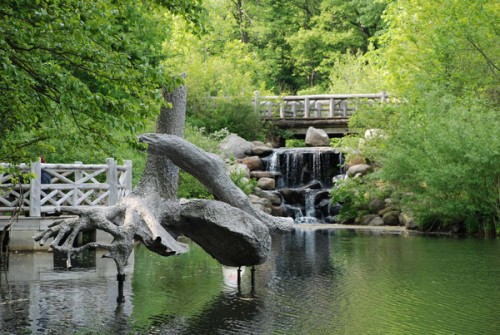
Sculptor Robert Lobe (b.1945) may not have the sensitivity of a Japanese gardener (his blunt forms are equally indebted to stage design, the art of trompe-l’oeil and the sculpture of David Smith), but his three hammered aluminum repousse sculptures– placed in and around Lullwater near the Boathouse in Prospect Park–wed Eastern and Western sensibilities.  Mr. Lobe’s hollow sculptures, which span nearly 12 feet by 14 feet, comprise aluminum plates, which are formed over large boulders and parts of trees and then combined and riveted into strange, bumpy, amorphous amalgamations that resemble petrified rock and wood, but which also can suggest monument and animal.

Each sculpture changes character in the round and changes color–from gleaming silver to driftwood-gray–in different light.  The crude cruciform “Antique Jenny” (2009-11) marks its place like an ancient headstone.  “Nature’s Clock” (2005-11) looks like a giant pile of kindling, yet its rock forms step upward with ceremonial conviction; and a tree form, splayed at its end, adds regal, crownlike flair.  Seemingly suspended above the surface of Lullwater is “Invisible Earth” (2007-11).  With the grace of a spider, it appears–in the water’s slow, mossy current–to creep along the surface of the lake.  Lurching, its forms intertwined-evoking lovers, a rogue wave, a sea monster and a mother and child–it transcends the elements of its fabrication.
Robert Lobe’s rural Repoussé

Skylands Visitor, , 03/20/2012

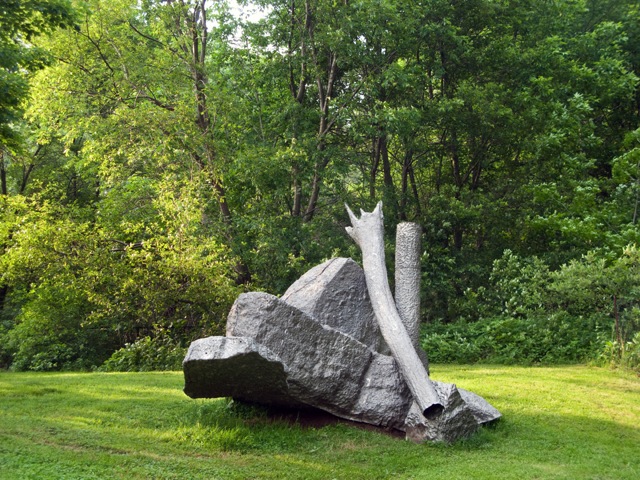
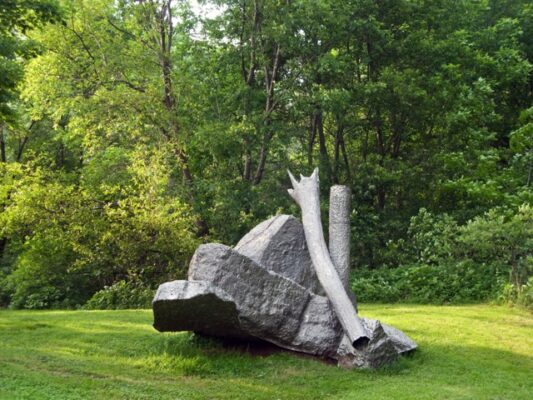
Embellishing the manicured landscape that surrounds the U.S. Geological Survey Building, in Reston, Virginia, an imposing metallic figure depicts a conglomeration of rocks and trees, leaning this way and that, yet bound together by nature’s timeless force. You might say the figure is a geologic survey in itself; it is a story told by natural elements found just below the Appalachian Trail in the woods of the Kittatinny Ridge in Sussex County, New Jersey. On the expansive government lawn in Virginia, the sculpture links the organic with the manmade, harmonizing the building’s natural setting with its horizontal geometry. The artist named this work “Harmony Ridge” for its role, and for the place from which it came.

As a young man, Robert Lobe sculpted wood, gravitating towards natural forms, exhibiting his work as early as 1969 at the Whitney Museum. He also liked cars, and with proceeds from a sale, acquired a 1958 Aston Martin, fitted with a 289 Ford Mustang engine and in dire need of bodywork. Taking on the task, Lobe got involved with how they made the car. Fancy automobiles—like Ferraris, Duesenbergs and Aston Martins—are made in far smaller quantities than Fords and Chevys. So few are made, in fact, that it doesn’t pay to set up for assembly line manufacture. The body of an Aston Martin is hammered out around a wooden form; each individually conformed to the shape, and then wheel-sanded to remove the marks from the power-hammer. On the inside, the thin, lightweight bodies are usually faced out with wood.

Fascinated with the process, Lobe went to the library and found an article in Popular Mechanics about dealing with dents through panel beating, a method evolved from an ancient metalworking technique known as repoussé. Lobe read about intricate old buildings in France that were constructed at their base with bricks and mortar, then higher with wood frames, faced out with stunning ornamentation in hammered copper. Malleable metals have been shaped and stretched with hammers since antiquity: Egyptian Pharaoh Tutankhamen’s mummy mask was fashioned from a single sheet of gold, hammered and inlaid with gems in 1330 BC. A larger and more familiar example is the Statue of Liberty, formed by copper repoussé, using wooden structures to shape each section during the hammering process.

Somewhere between King Tut and Lady Liberty, Lobe found his niche. He began to hammer aluminum around rocks blasted from the ground at the construction site of the World Trade Center and was excited by the capacity to capture the astounding interplay of surfaces, shapes, and textures created in these natural forms. His first, relatively small-scale sculptures were shown in 1976, but as his ideas grew more ambitious, finding places to express them became a challenge. His wife Kathy’s family had a summer home on Culver Lake, in Sussex County, that they visited on weekends from the city, so Bob knew about remote locations like Stokes Forest. But it’s an invasive process, bringing sheets of aluminum into the woods and pounding the metal to conform to huge boulders and trees. Lobe got himself kicked out of Stokes and other locations, so he began poking around the “neighborhood”, looking for a place to work.

In 1963, Ed and Doris Risdon bought 160 acres northeast of Culver Lake, backed up to the Kittatinny Ridge where it runs through the Sunrise Mountain section of Stokes Forest. They built a campground there, which they opened in the summer of 1966 and named Harmony Ridge Campground. “We came up here and found Ed and described what I do. He caught on and got all excited,” Bob Lobe recalls. “He took me around the woods at the base of the cliff at the top of the hill and showed me all this great stuff and told me to do whatever I want. This was in 1983.”

Since then, for nearly forty years, Lobe has come to create sculpture from the remote forest models at Harmony Ridge. Here, at the base of the final vertical rise to the top of the ridge, huge boulders have cracked away from the cliff, resting where they have lain for thousands of years. Season to season, the forest ebbs and flows around the rock, gaining footholds wherever possible, each member rising and falling, generation to generation. For an artist walking in these woods, the earth gushes a torrent of shapes and forms, angles and curves, textures and light, all vibrantly alive, yet frozen in a rhythm of life far different than our own.

Lobe started employing pneumatic tools in 1985, hauling an air compressor up the hill to facilitate stretching and shrinking the metal, encapsulating landscape. “Most of the work is setting up; the actual tooling goes very rapidly,” Lobe explains. “I know what’s going to happen. It’s like dress making.” With the hammer, he gathers the metal around the form, adding texture, which expands the surface area of the aluminum sheet.

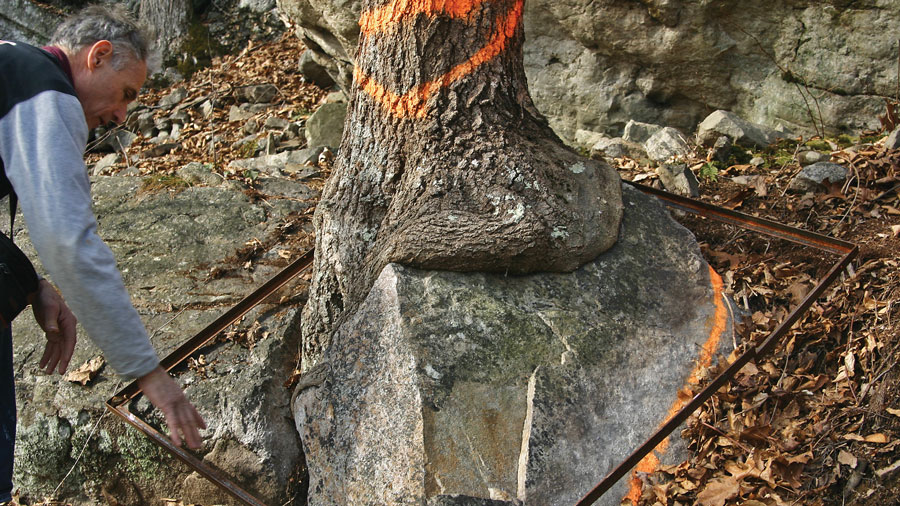
Bob’s most recent solo exhibition is an installation of three pieces at Prospect Park in Brooklyn, all modeled and conceived at Harmony Ridge. He describes how one sculpture, Invisible Earth, came to be. “I noticed this tree leaning against boulder, and it had exposed root structure. It was very animated, about to tip over. There was lots of potential energy: a pregnant situation. I see something like that, and I might not come back to it for ten years. Time flies! I came back and put some time into this one and found an idea about how to develop it. What brought it together for me was another tree that had fallen nearby, which I brought over, and it gave context and a narrative. I had to get to the bottom of the tree, so I pulled the rock away. The tree fell down within a week, and I could do the bottom of the roots. This is an aggressive structure and has heat treatment as well as interior members, an aluminum bridge and flanges inside. All told it was probably about a year’s worth of work. Once I had Prospect Park venue and funding, three large pieces came together at once.”

After countless mallet strikes, when Lobe is finished attaching and sculpting the sheets of aluminum to the form and texture of his model, the task of cutting the piece away for relocation begins, first to his Newark studio where he will stitch the sheets back together, sometimes revealing the joints, seams and bolts comprising the sculpture’s mechanical construction. Each piece must be transported again for heat treatment, in order to stabilize and strengthen the structure. Individual sections, welded together, must fit into a 5 x 5 x 6 foot oven where they are baked at 985 degrees for one hour, then quenched in cold water. The aluminum softens and becomes extremely bendable, and Lobe immediately returns to the factory and reassembles the entire sculpture. As the hours progress, the metal gets more difficult to bend until, by the end of the day, it becomes unworkable. To achieve the ultimate hardness, the sculpture is dismantled yet again, but this time into larger sections to fit into another oven, 6 x 6 x 12 feet at 350 degrees for twelve hours. At last the sculpture is brought back to the studio or place of exhibition for final assembly. The use of pneumatic tools and aeronautic metallurgy are a hi-tech twist to the ancient art of repoussé, uniquely employed by the sculptor to reinvent nature.

Lobe’s exhibition at Prospect Park, the installation for which the GMC Corporation lent vehicles and funding, is the latest of dozens of solo exhibitions across the country, dating to 1974. His work can be seen in numerous public collections, most notably the Solomon R. Guggenheim Museum and Whitney Museum of American Art, both in New York City; the National Gallery, Washington, D.C.; the Cleveland Museum of Art, OH; the Museum of Contemporary Art, Los Angeles, CA; the Museum of Fine Arts, Houston, TX; and the Walker Art Center, Minneapolis, MN. No less than seventy-five Robert Lobe sculptures come from the Kittatinny woods at Harmony Ridge, where there is always a finished piece on view at the campground for visitors to appreciate. And you can always find the models for those and future work—on permanent display, up the hill, way back in the woods.

Rock, Metal, Sculpture: Robert Lobe’s Imprint on Prospect Park

Brooklyn-based, By Stephanie Buhmann, Published June 10, 2011

Throughout this summer and fall, the grounds surrounding Prospect Park’s Boathouse will feature a sculptural installation by the New York-based artist Robert Lobe (b. 1945). It is the ideal setting for Lobe’s work, which takes inspiration from shapes and textures found in nature. These Lobe studies in particular were inspired by the woods in Northern New Jersey, near a section of the Appalachian Trail where he creates most of his works amidst the boulders and trees. For years, he has encased trees and rocks in sheets of malleable aluminum. Through countless mallet strikes, a pneumatic air compressor, and a variation of the ancient metalworking technique known as repoussé, in which metal is hammered around an object to obtain shapes and patterns, Lobe provides his subjects with a snug metal armor that both mirrors the characteristic surface of the contained, and renders it abstract. Meanwhile, joints, seams and bolts are left exposed to reveal the process of mechanical construction.

Commissioned by New York City’s Department of Parks & Recreation and the Prospect Park Alliance, Lobe’s outdoor exhibition “Nature in Nature” features three works, “Invisible Earth,” “Antique Jenny” and “Nature’s Clock.” They are located around the Park’s historic Boathouse, originally built by Frederick Law Olmsted and Calvert Vaux. While “Antique Jenny” is located on a grassy triangular intersection across from the park’s notable ancient tree the Camperdown Elm (made famous in the poem by Marianne Moore), “Invisible Earth” is installed within Prospect Park Lake, aka Lullwater. “Nature’s Clock,” the largest of the three, is situated on a small hill, chosen by Lobe for its resemblance to the sloped terrain of the Appalachian Trail near his home. (Prospect Heights Patch has pictures of all three.)

The invitation to create an installation in Prospect Park “came up late last October,” explains Lobe, who up to that date was unfamiliar with the grounds. “I started at Grand Army Plaza and worked my way in finding all kinds of places for these three pieces.” When he saw the Boathouse, things began to click. “I didn’t want to intrude on the picturesque masterpiece of [the location] but tweak along the periphery, where I felt these pieces would become fully realized.”

Lobe’s work addresses the divide between realism and abstraction. What looks like a tree stump from afar, turns out to be a metal object upon close inspection. What remains hidden from the eye however, is the fact that the metal is not cast but merely makes up a surface layer, obscuring the “nature” of the object underneath. While Lobe’s work references various historical and mythological concepts of nature, ranging from 19th Century Romantic landscape painting to Surrealism, it also addresses contemporary concerns. While digital reality increasingly blurs our perception of the natural world, Lobe’s work questions the essence, persistence, and fragility of nature.

“Nature in Nature” is not Lobe’s first public installation. Besides many temporary installations, Lobe has also completed commissions for the US Geological Survey Building in Reston, VA, in 1996 and for Eastern Washington University in 1993. But because of the many constraints with installation procedures, and the fact that these three major pieces are structurally complicated (he had to invent footing to install “Invisible Earth” in water, for example), “Nature in Nature” he says, is “by far the most difficult and ambitious installation to date.”


Stephanie Buhmann is a freelance writer based in New York. Her articles and interviews with artists have been published by Sculpture Magazine, Art on Paper, Chelsea Now, The Brooklyn Rail, The Villager, and Artcritical.com, where she is a contributing editor.

Robert Lobe found his California vibe

Robert Lobe’s sculpture Butterfly overshadows the pen-and-ink works on paper on the wall in the background.

Robert Lobe has been to California many times. But the month-long visit for his residency at the Luz Art Institute in Encinitas has been different, he says.

“I think I understand the California thing for the first time,” says Lobe, who grew up in Cleveland, graduated from Oberlin College in 1967, went to graduate school at Hunter College and has lived in New York ever since.

“There is a different sense of time, a kind of exuberant mood, which is also different than New York.”

You might not necessarily see an effect on the sculpture he completed during his four weeks in Encinitas, but it’s there, he says.

It’s in the leaves and the form of the slender tree that is part of Latin Lovers, he explains, which don’t resemble leaves so much as abstractions of the same. He’s constructed them to that they can flutter in the wind, an effect he has never tried before in his art until now.

Reesey Shaw, the director of the Lux, exhibited several of Lobe’s sculptures in 1995, as part of an excellent exhibition called “Landscape Revisited,” which she organized as director of the California Center for the Arts Museum in Escondido. And she has been intent on having him come for a residency since the Lux opened in 2007.

“The show is her slant on my work,” says Lobe. “Even my project (for the Lux) was influenced by her mind’s eye.”

He is happy for her slant, too.

“Of course I’ve seen these pieces in my studio. Digested them so long. Seeing them here transforms the work for me.”

He isn’t quite sure how to describe that new perception, other than to say it will lead to new work.

Lobe, now 64, attracted considerable attention beginning in the 1980s, through his inclusion in such shows as “Emerging Americans” at the Solomon Guggenheim Museum and the 1987 Biennial at the Whitney Museum of American Art exhibitions, along with solo shows at Blum Helman. His sculptures are presented in a long list of prominent collections, including the Storm King Art Center in New York and the National Gallery of Art in Washington, D.C.

He sees himself as connected to two streams in art history.

One is, in his words “a direct lineage with David Smith and Donald Judd.”

In different ways, they conveyed to him the value of geometry and the expressive surface.

Lobe’s hammered forms took hold in the mid-1970s. Lobe wasn’t living far from the site of the former World Trade Center, where the construction site gave him access to unwanted stone—a true love for his Stone Clones.

The other stream connects him to 19th century American landscape painters, like those who painted in the Hudson River Valley. (He lives in Manhattan with his wife, the widely exhibited painter Kathleen Gilje.)

“This American tradition is very important to me. A lot of these works are about place. A sense of place really is a primary thing to me. These are also plein air compositions, too, since they are sculptures made outside.”

With this attention to place, perhaps it’s inevitable that much of the work in this exhibition has a “Northeast feel” to him.

Lobe’s love of material has propelled him into trying different materials to get new effects in recent years. Grown Fast is symptomatic of that interest, with its stainless-steel surface, far shinier than any of the other works on view. His foray into cast bronze, with Tap Root, appears to please him, too. It abstracts the shape of a tree trunk.

His trademark hammered works were originally done by hand, but about 1983, he started using pneumatic tools to speed the process.

“Setup and planning are everything. The hammering is actually fun.”

The Santa Fe New Mexican/Pasatiempo – Robert Lobe: Seize the Trees

If trees shed their skin like snakes, the world’s forests would be littered with castings that resemble Robert Lobe’s art. His sculpted trees are eerily realistic, but, he says, he is not interested in mimicking nature. “I think the work comes out of classical sculpture – that includes modernist sculpture through Donald Judd and minimal art. In part, it begins with process – the idea of hammering aluminum around trees, the idea of all that detail being condensed and focused on the skin.”

At one o’clock on a recent afternoon, Lobe answered a call to his studio. As is often the case, Lobe was working in a forest in eastern New Jersey, not far from his New York City studio. The cellular connection was surprisingly clear. “This place becomes like the inside of my mind – I know it so well,” Lobe said.

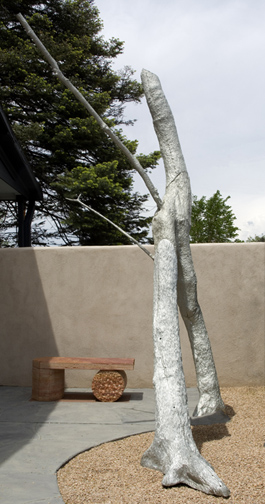
Lobe encases trees and rocks in sheets of aluminum, using mallets and a pneumatic air compressor to stretch and tighten the metal. He uses several gauges of aluminum sheeting on each sculpture. Thin-gauge metal conforms snugly to the texture of tree bark or granite. The thousands of indentations he leaves on thicker gauges of metal create a surface the artist calls “fictitious.” Such patterns suggest textured bark, but on close examination, Lobe’s dents look more like fractured stone. His method is a form of repoussé, a technique in which metal is hammered, usually from the inside, to create designs or forms. In the third century B.C., Greeks used repoussé to produce armor plates. Perhaps the best-known modern piece of repoussé is a 19th-century copper building made by a Frenchman: Liberty Enlightening the World, better known as the Statue of Liberty.

Two of Lobe’s smaller works – Walking Tree, at just over 11 feet tall, and Summer Sound, which is a little more than 8 feet in height – are included in Modern Dimensions: Contemporary American Sculpture, the inaugural show at Eight Modern. The Delgado Street gallery is one of the newest in the Canyon Road area.

Summer Sound is an assemblage of rock, branches, and trunk that represents elements from two sites, Lobe said. But Walking Tree was molded from a single model he found in the Adirondack Mountains in New York. Lobe was unable to carry his 250-pound air compressor up the steel incline to the tree, so he cut it into pieces and carried them to his truck. The length of the dominant trunk was made in sections, which Lobe assembled slightly askew. Thousands of elongated hammer marks twist along its length, and these dents sometimes take turns that seem less than natural.

“Walking Tree was such a fantastic subject to work with; it generated so much interest,” he said. “There’s a riddle in that piece. These are things that you can’t process. They just keep coming back into your head. These are things that you couldn’t talk about; you have to see it.”

Lobe’s larger works present additional challenges. To make impressions of giant boulders and trees, the artist carries his tools to his models, and after hammering aluminum around their girth, he has to cut it free. Later, in his studio, he reassembles the silvery membranes, making no effort to disguise the seams. In the final stage, the sculpture is heat-treated and sometimes anodized. The gray-silver surface of heat-treated aluminum reflects light like metallic ash, causing many observers to comment that Lobe’s art has ghostly qualities.

When Lobe began making aluminum sculpture during the 1970s, his work seemed out of step with the art world. Michael Heizer was bulldozing massive amounts of earth in Southwester deserts, and Robert Smithson had recently completed his Spiral Jetty in Utah’s Great Salt Lake. Such “earthwork” artists applied minimalist ideas to the landscape, Lobe said, but his work grew out of a different impulse – a need he felt when surrounded by nature in all its randomness and chaos.”

“There is a whole part of nature that is so vast you want to incorporate it,” Lobe said. “You want to incorporate the way it looks, and you can do that if you touch it. Even though you can’t touch the top of the mountain with your hands, you have a desire to be there and to feel it because it’s so vast. It goes back to classical landscape, but it’s not so much about the insignificance of a single person or the glory of the universe. It’s just a kind of hormonal thing, and it’s great.”

Lobe admits that some his art has an anthropomorphic character. “In order to keep it in the realm of sculpture and art and not have it turn into some animalistic entity that just needs life breathed into it to walk away, I have to keep everything in balance,” Lobe said. Some of his trees echo ancient bronzes like the Charioteer of Delphi, circa 470 B.C. Excavated in the sanctuary of Apollo at Delphi, the ancient Greek charioteer feels ancient and grounded. Similarly, Lobe’s trees which are also much like columns, seem oddly rooted and able to withstand a storm or two.

Like ancient bronzes, Lobe’s forest repoussés are hollow, but classical sculptors always created a sense of stability, while Lobe celebrates hollowness. He lops off the ends of branches, leaving pipe-like openings. Holes left by pneumatic tools and cracks where metal has stretched beyond the breaking point allow glimpse into the sculpture’s dark interior.

Lobe’s repoussé pieces can be thought of as the residue of the artist’s experiences of touching nature. “There’s something that you can’t identify or define, but you have to touch it,” Lobe said. “And you remember it. You can’t recreate it in your mind because it’s so specific, and each time you see it, it’s different. There is something about grasping it in a very physical, tactile way that people relate to.”

Critical Reflections: Modern Dimensions: Contemporary American Sculpture

THE Magazine, Jon Carver, 2007-06-01

Have you had the Eight Modern experience? Have you seen the glorious spanking new white walls, the luscious picture windows, and the dynamically subtle modifications they’ve made? If you want your beautiful old adobe to look like the Museum of Modern Art, this new gallery on Delgado Street is a total style pointer. It’s all about doors and windows, entry and light. Who cares that somewhere in the seventies Modernism puttered out of the great game of miniature golf we’ve all come to know and love. Rumor is they plan to change the name of that particular stretch of Delgado to Modern Street soon, anyhow.

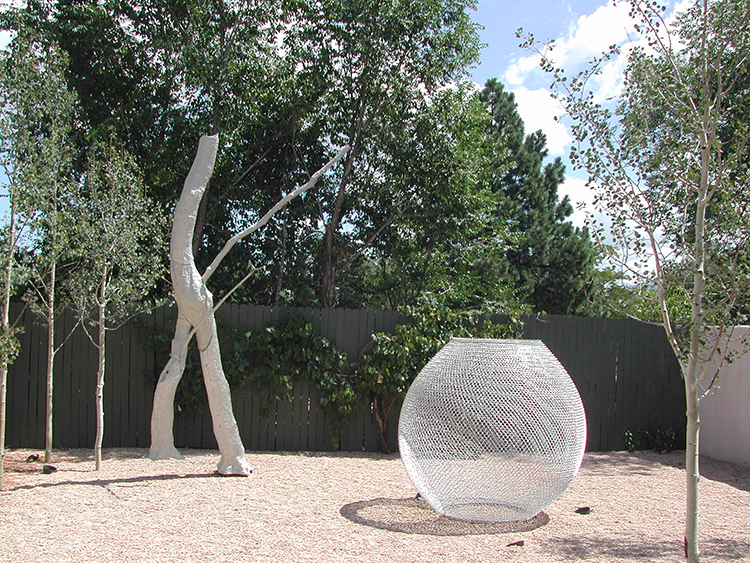
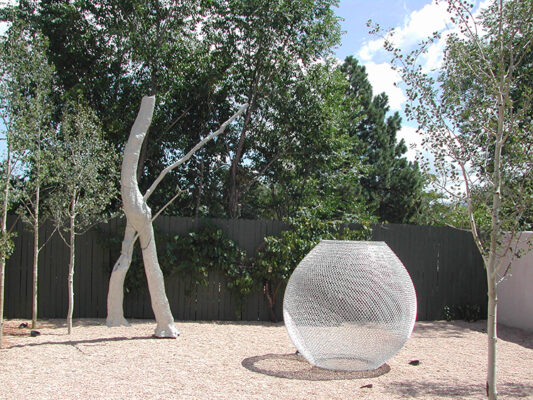
We like round shiny things, we humans, we crows, we raccoons, and we modernists. If its curves gleam, we like it. We like the chain link spheres of John Ruppert made large in aluminum and steel. We like ’em for their transparency, their volume, their engineering, and their shiny curviness. We like ’em like we would like giant soap bubbles set down on the lawn, or alien robot pod husks filling the veranda, or spheroids of positive love vibration preparing to pollinate. We like ’em better than a grand piano and they’re musical in a whole different way.

Oh so boldly, the new gallery led off with a power-packed show of sculpture. Walter Dusenbery, once an assistant to the venerable Isamu Noguchi, filled several rooms with his pink travertine Minimalism. Like Noguchi, Dusenbery strives for elemental forms with universal appeal that seem both ancient and modern (there’s that word again). Dusenbery’s chosen material is the only carving stone that hardens in response to acid rain. While the marbles of the ancient world are rapidly melting away, Dusenbery’s travertines are firmly set on a foundation of architectonic timelessness.

Celeste Roberge presented an up-to-date stainless-steel chaise longue packed with river rocks in the lovely sculpture garden. Her works revolve around a bizarrely charged interest in furniture and fossilization. The most compelling pieces in the show are her miniature stackings of tiny objects and plaster. Their scale and intimacy reward intense contemplation, and they come as a welcome refreshment to all this Modernist monumentality. There’s a little Louise Bourgeois here and a touch of Robert Morris. Roberge is an artist we’d like to see more of. Warning: she may actually be post-modern.

Or simply surreal (the first pro-modernism), like Nancy Youdelman, an assemblagist who was a member of Judy Chicago’s first class in Feminist Art at Fresno. Her accumulated dresses are dense with ghosts of memory, and stand up especially well in bronze. An echo of the feminist art strategy–in which obsessive decoration becomes subject–is heard, but digging deeper each piece tells a woman’s story in the fragile voices of fading photographs, love letters longingly squeezed between ribbons and medals of valor, parched paper, dried flowers, butterfly buttons, thimbles, cymbals, trinkets, fancy pins, and souvenirs. Her approach to assemblage resonates with the modes of local artists Gail Reike and Andrea Senutovich.

Modes. Doesn’t that have something to do with modern? In China, cherries mean good luck in love. I believe in America there is a similar symbolic linkage, though it remains mainly in the crass parlance of the collective unconscious, so maybe your new mode ought to be like Ming Fay’s, in which there is no culture, only the elevation of nature. His sculptural gardening produces fruit, such as his oversize maraschino cherry dropped in the center of the space as if the gallery was a great big Manhattan cocktail. Robert Lobe uses a repoussé technique (it sounds French, but he’s cleared it with the administration) and large sheets of aluminum to record and abstract the surfaces of trees and rocks. Two large branching configurations, “machines” as he calls them when he feels constructivisty, hung alongside the gallery. Shiny, we like shiny, and these were. And Naumenesque was the sense of displacement (From the forest floor to floating above the side courtyard), making them all the more abstract and also slightly menacing.

Finally, we find the work of Robert Mangold. His colorful, pointy, tubular sculptures zig and zag like playground equipment made out of lightning bolts. Though they are pleasant enough in their sharp-angled way, they also make it clear that one of the pitfalls of Modernism is an overdependence on form all by its lonesome. Form is finem but sometimes the Modern seems to play it safe by striking more significant content. More artists like Celeste Roberge are the answer. Still and all, Eight Modern is off to a stunningly good start.

PRESS RELEASE – Modern Dimensions: Contemporary American Sculpture

SANTA FE, NEW MEXICO – Eight Modern celebrates its grand opening with the inaugural exhibit, Modern Dimensions: Contemporary American Sculpture. The exhibition brings together works by seven American sculptors: Walter Dusenbery, Ming Fay, Robert Lobe, Robert Mangold, Celeste Roberge, John Ruppert, and Nancy Youdelman. Each of these highly-acclaimed artists explores diverse facets of contemporary sculpture and integrates conceptual and aesthetic ideas in bold, new terms.

In developing Modern Dimensions: Contemporary American Sculpture for its grand opening, Eight Modern declares its confidence in establishing a unique venue imbued with history yet situated on the leading-edge. Analogously, the exhibit signifies the gallery’s commitment to premiering works by internationally acclaimed artists who have never before been represented in Santa Fe.

Walter Dusenbery’s sculptures are at once classically-inspired and wholly innovative. An assistant to Isamu Noguchi in the early 1970s, his works in stone apply classical ideals to organic forms and complement imposing grandeur with a sensuousness born of technical mastery. Dusenbery’s sculptures are held in several of the world’s most impressive collections including the Metropolitan Museum of Art and the Solomon R. Guggenheim Museum, New York.

Ming Fay’s elaborate multi-media sculptures are derived from organic sources, such as seed pods, vegetables, weeds, and other biomorphic forms. His work references the complex issues of Chinese folklore, botany, and contemporary urbanity. In addition to having received numerous awards for public works commissioned by organizations such as MTA Arts for Transit, Fay has held acclaimed solo-exhibitions in the world’s leading arts venues including MOCA Shanghai and the Whitney Museum, New York.

Robert Lobe sculpts sheets of aluminum to the spatial outlines of landscape configurations using a repoussé technique. His sculptures are not only haunting spectral images of nature abstracted, they represent an extreme re-contextualization of mechanical materials – stretching the parameters of industrial forms and methodologies. Lobe’s sculpture attained national recognition when it was prominently featured in the Whitney Museum’s famed exhibit, “Anti-Illusion.” His work is included in the collections of such noteworthy institutions as the National Gallery, Washington, D.C, and the Solomon R. Guggenheim Museum, New York.

Robert Mangold’s primary artistic concern is the relationship of time and space as expressed through movement in sculpture. His series, PTTSAAES (Point Traveling through Space at an Erratic Speed), explores implied motion. In his daring works, ‘Point’ and ‘Space,’ respectively, are defined as the roving focus of the viewer’s gaze and the time in which one’s visual attention is transferred between segments of his geometric compositions. Exhibiting internationally since the early 1960s, he has won numerous awards including the Henry Moore Grand Prize from the Hakone Open-Air Museum, Tokyo.

Celeste Roberge investigates the intersection of geological and human forms. Melding the forms of river rocks, 19th century furnishings, and stainless steel, she focuses the viewer’s experience on the visceral impact of collided opposites: the fabricated pressed between the organic, the inviting caught in the threatening, and the ephemeral embedded within the enduring. Prompting her viewers both to abstract time and to sense its immediacy, Roberge’s work engages not only the concepts of pure archaeology but also the continual excavation of desires that the chaise lounge, the iconic fixture of the psychiatrist’s office, evokes. She is the recipient of the prestigious Pollock/Krasner Foundation Grant.

John Ruppert’s sculptures address the dynamics of change. Translating vegetal forms into industrial materials, he both asserts and defies the inevitability of natural phenomena, and invests his subject matter with abstract qualities by stripping them of their original colors, details, and textures. His series of airy chain-link vessels evoke constructed boundaries, yet their delicate forms integrate fully into their surrounding environments. Exhibited and collected internationally, reviews of his work have been published in Art in America, Sculpture, and the New Art Examiner.

Nancy Youdelman centers on the relationships between objects and memory, eliciting feelings of adoration, nostalgia, and lost hope. Her mixed-media assemblages integrate personal artifacts and natural materials with girl’s and women’s clothing. Exalting and concentrating memory, her works recast as sublime the forgotten objects of quotidian experience. A leading authority and practitioner in the field of Feminist Art who has studied extensively with Judy Chicago, she is the recipient of numerous awards including recent grants from both the Pollock/Krasner and the Adolph and Esther Gottlieb Foundations.

Modern Dimensions: Contemporary American Sculpture will run from Friday, May 4, through the summer. Eight Modern is open daily from 9:30am to 6:00pm at 231 Delgado Street, Santa Fe, New Mexico 87501. For further information and image requests, contact Alex Ross via email at alex@eightmodern.net or by phone at (505) 995-0231.

Robert Lobe – New Work

Robert Lobe’s sculptures astonish, in this déjà vu art world, with their grandeur and originality of vision. Of his new works, both wall pieces and freestanding tree sculptures, Lobe says that he is “returning to nature in a new way, more conscious of the sublime– a sublime both fearful and beautiful.” This attitude toward nature places him as a Northern Romantic; and in his treatment of landscape, which magically fuses the scientific and the ecstatic, there are analogies to American Transcendentalism.

His recent New York exhibition showed important new developments from his previous work. A deftly affirmed contrapuntal relation between realistic nature and abstraction has always been fundamental to his sculpture. But in his new show, both the bas-reliefs and the freestanding tree works are far more abstract– further from the motif– than any of Lobe’s other works from the past 25 years. In both genres, the artist now “rearranges” the nature that he selects to be shaped and hammered into art.

Peacepipe, Vine, and Page 1, Vol. 11 all demonstrate this move toward greater abstraction. They are composed in a freer way, with a virtuoso treatment of surface. Lobe says that his use of much thicker aluminum sheets, which he anodizes, allows him to work the aluminum “like clay.” Thus, he can create voluptuously articulated surfaces, with whorls of molten metal and labyrinths of lines within a volcanic terrain. Truly “abstracted” from the original object or site in nature, these works are more Lobe’s conception of particular natural elements than literal re-creations of those elements themselves.

The new wall piece, Vine (1999), with its extravagant silhouette and a surface that is both meticulous and sensuous, is emphatically Baroque in its theatricality, plunging diagonals, and complex patterns of movement. The edges, also Baroque in character, alternate between sharpness and fluidity, giving the work a dramatic tactility. In Vine, Lobe adapts the technique of radically opposing directional movement: one mass of volumes moves left, the other right, creating a mood of energy and majesty.

All of the wall pieces embody the virtuoso themes of regeneration and metamorphosis, so favored by sculptors such as Bernini. Of the bas-reliefs, while Vine continues the triumphantly Baroque tone, compelling in its vertiginous stance and lush, complex rhythms, Peacepipe (1999) and Page I, Vol. 11 take a decidedly classical stance: serene, balanced, taut, and centered.

Lobe sees the bas-reliefs, particularly Page I, Vol. 11 and Vine, with their elegantly broken, irregular edges, as “pages torn from a notebook– the notebook of nature.” The analogy to pages or drawings is apt, as Lobe, with his hammering tools, “draws” on the aluminum sheets.

As concentrated distillations of a whole, these works have immense power. Lobe knows that the fragment has an undiluted energy and plastic unity that the whole may not. In these works, the formal qualities themselves-the volumes, the mass, the lines, the edges, the rhythms– are so precise as to symbolize the whole. Surely these surfaces, where light makes the forms dissolve and merge, creating an image of a world in movement, read as microcosms of pitted and fissured matter. The bronzed surfaces reveal a substructure of turbulent and restless volumes.

Stark and calligraphic, Lobe’s rhythmic groupings of trees show an inward and perceptual relationship to nature. To the artist, they are “interior landscapes.” There is a spare and linear elegance to the tree works and a spatial symmetry that suggests an Eastern aesthetic. In the wall pieces, Lobe gives the energies of art and nature equal power; in the tree works, he suggests that art has the greater voice. The beauty of the compositions, both as individual units and as a group, lies in the inexhaustibility of viewpoints. The accents–stones on the branches–are like music, creating a spare rhythm.

As Barry Schwabsky recently noted in Art in America, most sculptors who supposedly deal with nature have no spiritual or philosophical relationship to it. The United States may possess vast expanses of extraordinary natural landscape, but we Americans do not believe in it. While we are at home in nature, nature is not our home.

As seen in Malagash– Place of Games (1980), Lobe’s affirmation over 20 years ago of the ancient but forgotten truth of man’s interdependence with nature relates to American Transcendentalism. He has surely achieved his own transcendental sublime. His unique achievement recalls the words of Leonardo da Vinci, who praised artists “capable of disputing and contending with nature.” Lobe’s sculpture suggests a possible mediation between human existence and the larger natural world. He is an important sculptor not only for his formal qualities but also for the authenticity and relevance of his vision.

Margaret Sheffield is a writer living in New York City.

Tuesday–Saturday
10am–5pm


1601 Paseo de Peralta
Santa Fe, NM 87501
(505) 984 1387

FB LinkInstagram LinkYouTube LinkPinterest LinkTwitter LinkArtsy Link

/detail/?artistId=158350&offset=0&historic
/detail/?artistId=131353&offset=0&historic
/detail/?artistId=131313&offset=1&historic
/detail/?artistId=438148&offset=0&historic
/detail/?artistId=131261&offset=1&historic
138778
379223
324077
131264
131282
131283
131284
437132
290764
132133
354172
156549
131288
437130
131267
132134
438817
131289
131258
131320
131291
275525
131293
137906
131295
290914
137911
131297
131298
131276
131280
131299
131266
137912
131301
280559
437134
131356
131321
430063
131307
131305
131306
131309
131257
131322
437128
131274
131311
131259
131271
131316
131287
131008
130963
131049
131085
131164
131109
130991
130888
274796
131047
130966
440262
130977
131340
131087
130878
131086
436152
131097
130918
131088
444068
130970
337609
130883
131057
439293
131096
130968
131247
337926
130895
130893
131043
130917
130920
130905
131228
131143
131008
130963
131049
131085
131109
130991
130888
131047
130966
440262
437132
130977
437130
131340
131087
130878
131086
436152
131097
131088
444068
130970
337609
130883
131057
439293
131096
130968
131247
337926
131043
130905
437128