Buseki Suiko
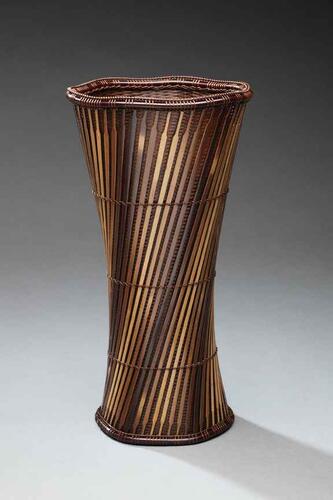
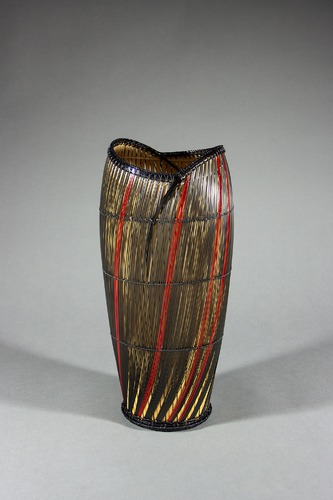
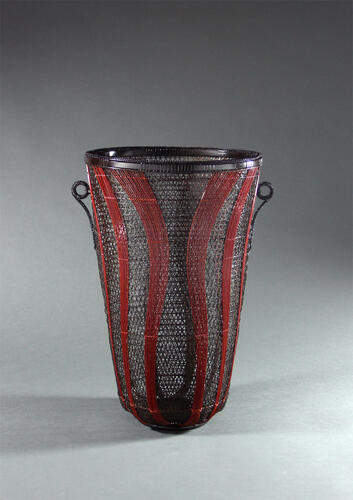
“Bamboo, you know, no matter how thin you split it, it is still very strong and powerful. I am attracted to the visual strength of its tautness and tension as well as the charm of the material, its lightness, and its moiré effect created by open plaiting works. Open work is possible because of the inner strength of this medium. It creates beautiful transparency.”
Many of Suiko’s works are flower vessels, in which the beautiful openwork technique is utilized. He does not limit his work to using only new bamboo. For example, “susudake,” a 200-year-old bamboo used in sunken hearths, is also used as a material. The deep, blackened texture of this material is quite appealing.
“The tools used for this delicate bamboo work are quite simple, and there are only a few of them that he uses. Woodworkers use many kinds of planes, but bamboo work is quite different. In my case, I mainly use one small knife, three machetes, and only hand tools to sharpen my work.”
“I think that tradition is very precious. Whether it is technology or tools, there is nothing unnecessary. Only what is necessary remains over time. I think it is wonderful what our predecessors achieved over a long period of time. I would like to make use of these 200-year-old things in contemporary design. I would like to see “movement” in the design. I want to create dynamic, rather than static, bamboo work.”
BUSEKI SUIKO
b. 1958 Tokyo, Japan
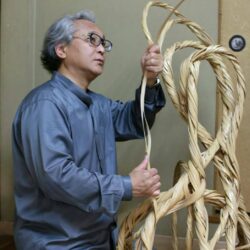
Buseki Suiko was born in 1958 and is the third generation in a family of bamboo artists. He was trained in the art of bamboo basketry under his father, Suigetsu, and grandfather, Suishin, and later under Living National Treasure Iizuka Shokansai. He has had a prolific career, exhibiting in many prestigious shows, including the Japan Traditional Craft Arts Exhibition in 1986. He has also had many solo and group shows internationally, the most notable of these being the 60th anniversary of the Japan Traditional Crafts Exhibition at KOGEI at The National Museum of Modern Art in Tokyo, as well as exhibiting pieces in Japanese Bamboo Art: The Abbey Collection at the Metropolitan Museum of Art in New York.
His refined and intricate artworks are made possible by mastering a high level of plaiting skills. His works are in the collections of leading museums both inside and outside the country, including The National Museum of Scotland (UK), The Metropolitan Museum of Art (USA), and the Imperial Household Agency in Japan.
Education
-
1985
Graduated from the Oita Prefectural Bamboo Craft Training Center
Studied under his grandfather, Suishin; his father, Suigetsu; and later, Iizuka Shokansai (Holder of Important Intangible Cultural Property)
Exhibitions + Accolades
-
1986
Selected for the first time at the Japan Traditional Craft Arts Exhibition and thereafter many times (winning two major prizes)
- 1999: NHK Chairman’s Award
- 2002: Japan Kōgeikai Encouragement Award
-
1987
Selected for the Exhibition of Traditional Crafts of Eastern Japan every year since his debut selection (winning two major prizes)
- 1994: Asahi Shimbun Company Award
- 2025: Isetan Mitsukoshi Award
-
1988
Awarded for the first time at the Traditional Crafts Wood and Bamboo Exhibition and thereafter many times (winning three major prizes)
- 1996 & 2007: Tokyo Metropolitan Board of Education Award
- 1998: Japan Crafts Association Award
- 2000: Asahi Shimbun Award
-
2009
Sent to Germany on a cultural exchange mission of the Agency for Cultural Affairs, toured five cities giving lectures, public demonstrations, and surveys of museum bamboo art collections.
-
2010
“Contemporary Tea Ceremony: Use and Form” at Kikuchi Kanjitsu Memorial Tomo Museum, Tokyo
Solo exhibition at Mitsukoshi Department Store Art Gallery, Nihonbashi, Tokyo
-
2012
Won the Art Fund Award for Collect Exhibition, London, UK
-
2013
Exhibited at the Contemporary Japanese Crafts Exhibition, Morikami Museum and Japanese Garden, Miami, FL
Participated in the 60th anniversary of the Japan Traditional Crafts Exhibition at KOGEI, The National Museum of Modern Art, Tokyo
-
2015
Exhibited tea utensils at the Dainippon Tea Ceremony Society exhibition “Senshinkai” at Mitsukoshi Department Store Art Gallery in Nihonbashi, Tokyo
Exhibited in the Craft Art Today-Kikuchi Awarded Crafts, Kikuchi Kanjitsu Memorial Tomo Museum, Tokyo
-
2016
Solo exhibition, Mitsukoshi Art Gallery, Nihonbashi, Tokyo
-
2017
Exhibited in the “Japanese Bamboo Art: The Abbey Collection,” Metropolitan Museum of Art, New York
Exhibited in the Okada Mokichi Prize Exhibition at MOA Museum of Art, Atami City, Shizuoka, Japan
Exhibited in the “Eighty-Three Great Treasures of the Heisei Era,” Yakushiji Temple, Nara
-
2018
Exhibited at the Dai Nihon Chado Gakkai tea ceremony utensil exhibition “Senshinkai” at Mitsukoshi Department Store, Nihonbashi, Tokyo
Exhibited in Japonisme 2018, Paris, France
-
2019
Exhibited in the Okada Mokichi Prize Exhibition, MOA Museum of Art, Atami City, Shizuoka, Japan
Exhibited in “Bamboo Crafts 201,” Nihonbashi Takashimaya, Tokyo
-
2020
Exhibited in “Kōgei 2020—The Art of Crafting Beauty from Nature,” Tokyo National Museum, Hyokeikan Gallery, Tokyo
Solo exhibition, Mitsukoshi Art Gallery, Nihonbashi, Tokyo
-
2022
Exhibited in the Agency for Cultural Affairs sponsorship folkcraft exhibition “Deepening, Broadening, and Expanding Traditional Crafts” Mitsukoshi Art Gallery, Nihonbashi, Tokyo
-
2024
Received the 2nd “Japan Crafts Association Member Award” Asuka Cruise Prize
-
2026
Exhibited in “Grass Scripts: Bamboo Art from the Abbey Collection”, Denver Art Museum, Denver, CO
Museum Collections
-
Imperial Household Agency, Tokyo
Gotoh Museum, Tokyo
The Hasegawa Machiko Art Museum, Tokyo
National Gallery of Scotland, Edinburgh, UK
Hamburg Museum of Art & Design, Hamburg
Metropolitan Museum of Art, NY
Yakushiji Temple, Nara
Sanzenin Temple, Kyoto
“Bamboo, you know, no matter how thin you split it, it is still very strong and powerful. I am attracted to the visual strength of its tautness and tension as well as the charm of the material, its lightness, and its moiré effect created by open plaiting works. Open work is possible because of the inner strength of this medium. It creates beautiful transparency.”
Many of Suiko’s works are flower vessels, in which the beautiful openwork technique is utilized. He does not limit his work to using only new bamboo. For example, “susudake,” a 200-year-old bamboo used in sunken hearths, is also used as a material. The deep, blackened texture of this material is quite appealing.
“The tools used for this delicate bamboo work are quite simple, and there are only a few of them that he uses. Woodworkers use many kinds of planes, but bamboo work is quite different. In my case, I mainly use one small knife, three machetes, and only hand tools to sharpen my work.”
“I think that tradition is very precious. Whether it is technology or tools, there is nothing unnecessary. Only what is necessary remains over time. I think it is wonderful what our predecessors achieved over a long period of time. I would like to make use of these 200-year-old things in contemporary design. I would like to see “movement” in the design. I want to create dynamic, rather than static, bamboo work.”